Floating Frisbee for Dogs: 6 Tips for Teaching Water Fetch (From a Dog Who Hated Water)
I’ll be honest: my first attempt at water fetch was a disaster. Two summers ago I took my friend’s lab, Biscuit, to the lake with a regular hard-plastic frisbee I’d grabbed from a supermarket shelf. I threw it. It plopped into the water, bobbed twice, and sank out of sight in about four seconds. Biscuit stood on the shore, stared at the spot where his toy had vanished, and refused to go in past his ankles for the rest of the afternoon.
Here’s what I’ve learned since: most dogs don’t hate water. They hate being thrown into the deep end — literally — with the wrong gear and zero warm-up. If your dog freezes at the water’s edge, the problem is almost never the dog. It’s the setup.
1. Start where they can touch the bottom
Don’t launch a frisbee into the middle of the lake on day one. Wade in yourself first, knee-deep, and toss it two meters — barely a throw. The dog follows you in because you’re there, not because of the toy. Biscuit needed three visits before he’d swim past the drop-off. Some dogs need ten. That’s fine. Rushing this step is how you create a dog that hates water for life.
2. Use a frisbee that actually floats (sounds obvious, isn’t)
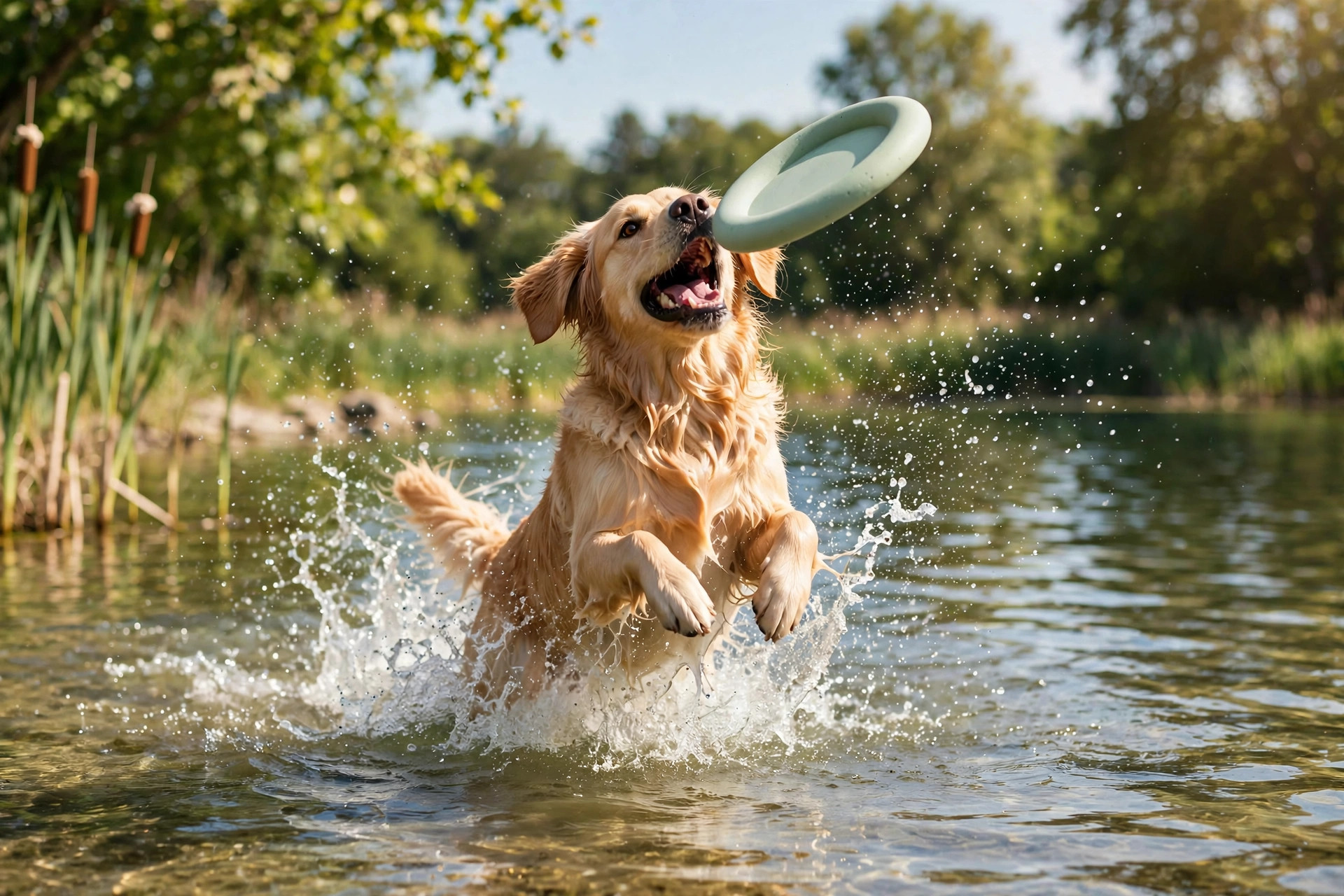
This is where I wasted money. A regular frisbee sinks. A tennis ball gets waterlogged and goes under after a few minutes of paddling around it. What you want is a buoyant foam core that rides high on the surface — the dog can see it and grab it without dunking its whole head underwater. The Splash Flyer weighs just 130 g and its foam core keeps it floating on top; Biscuit could spot it from ten meters out and plan his approach instead of panicking.
3. Soft rim, or don’t bother
Here’s an opinion: hard plastic discs are not worth buying for water fetch. When a dog catches a frisbee mid-air, it catches it with its teeth — at speed. A rigid edge can bruise gums or chip a tooth, and I’ve seen it happen. A soft, flexible rim deforms on impact instead of fighting the jaw. The Splash Flyer uses a soft TPR and EVA foam rim for exactly this reason, and it’s non-toxic and BPA-free, which matters when the thing spends half its life in your dog’s mouth.
4. Bright colors are a feature, not fashion
On open water, a white or dull-colored toy disappears against the glare. Bright orange or blue — high-visibility colors — means you can track it and so can your dog. Thirty seconds of swimming in circles looking for a lost frisbee is thirty seconds of wasted energy and rising panic. Visibility is a safety feature.

5. It’s a fetch toy, not a chew toy — supervise
This one comes straight from the care instructions and it’s worth repeating: the disc is puncture-resistant TPR, built to survive enthusiastic chewers during play, but it’s not designed to be gnawed on for an hour while you scroll your phone. Watch your dog, especially the power chewers. Take the frisbee away when the game ends and it lasts for years — a customer told me theirs survived two full summers of weekend lake trips.
6. Rinse it after saltwater or pool sessions
Salt and chlorine are rough on everything, toys included. A quick rinse with fresh water and air dry takes forty seconds and keeps the foam from getting crusty. It’ll fly straighter too — the Splash Flyer is rated to fly up to 30 m, and a clean, balanced disc is noticeably easier to throw far. Thirty meters of flight is no joke when your dog is already sprinting; a wobbly throw lands short and confuses them.
A word on water safety, because it matters more than any toy
Current and undertow are the real danger, not the frisbee. Rivers and ocean surf are advanced mode — start at a calm lake with a gentle slope. Weak swimmers, puppies, and short-nosed breeds should wear a dog life vest; there’s no shame in it, and the good ones have a handle on top so you can lift your dog out fast. And near the shore, keep a long leash on until recall is rock solid. Our Roam Retractable Leash gives 5 m of freedom while you keep control — enough room for a dog to splash, short enough to reel in.
You know what’s funny? Biscuit now drags me to the water. Last month he swam out fifteen meters, grabbed his frisbee, and brought it back prancing like he’d won the lottery. The same dog who wouldn’t go past his ankles.
If your dog is still in the ankle-deep phase, that’s okay. Get the right frisbee — one that floats high, feels soft in the mouth, and that you can actually see on the water — and let them figure out the rest at their own speed. The water isn’t going anywhere.
Tried and tested at Fuzzhop: the Splash Flyer – Floating Dog Frisbee (130 g, floats high, soft tooth-friendly rim, flies up to 30 m). Pair it with the Roam Retractable Leash – 5m for safe shoreline sessions.
Home Alone 9 Hours a Day? How to Keep an Indoor Cat Happy While You Are at Work
I leave the apartment at 8:40 every morning. I get back around 7 in the evening. That’s more than ten hours my cat spends home alone — and for the first year, I told myself she was fine, because cats sleep all day, right?
She does sleep a lot. Fifteen, sixteen hours, easy. But here’s the math nobody mentions: that still leaves eight waking hours, and roughly five of them happen while you’re gone. A bored cat doesn’t just nap through it. Mine started doing 3 a.m. parkour across my bookshelf. Then the arm of my sofa started looking like shredded wheat. Then came the 5 a.m. meowing concerts outside my bedroom door.
So what actually helps? Let me save you some money first: leaving the TV on for your cat all day is a waste of electricity. I tried it for a month. She slept through every nature documentary. Those “calming music for cats” playlists? Same story — snored straight through. Don’t buy the hype, and definitely don’t buy a second tablet “for the cat.”
What does work is giving them something to do. Two things changed my cat’s daytime life, and neither one needs me in the room.
1. A toy that plays back: the self-rolling ball
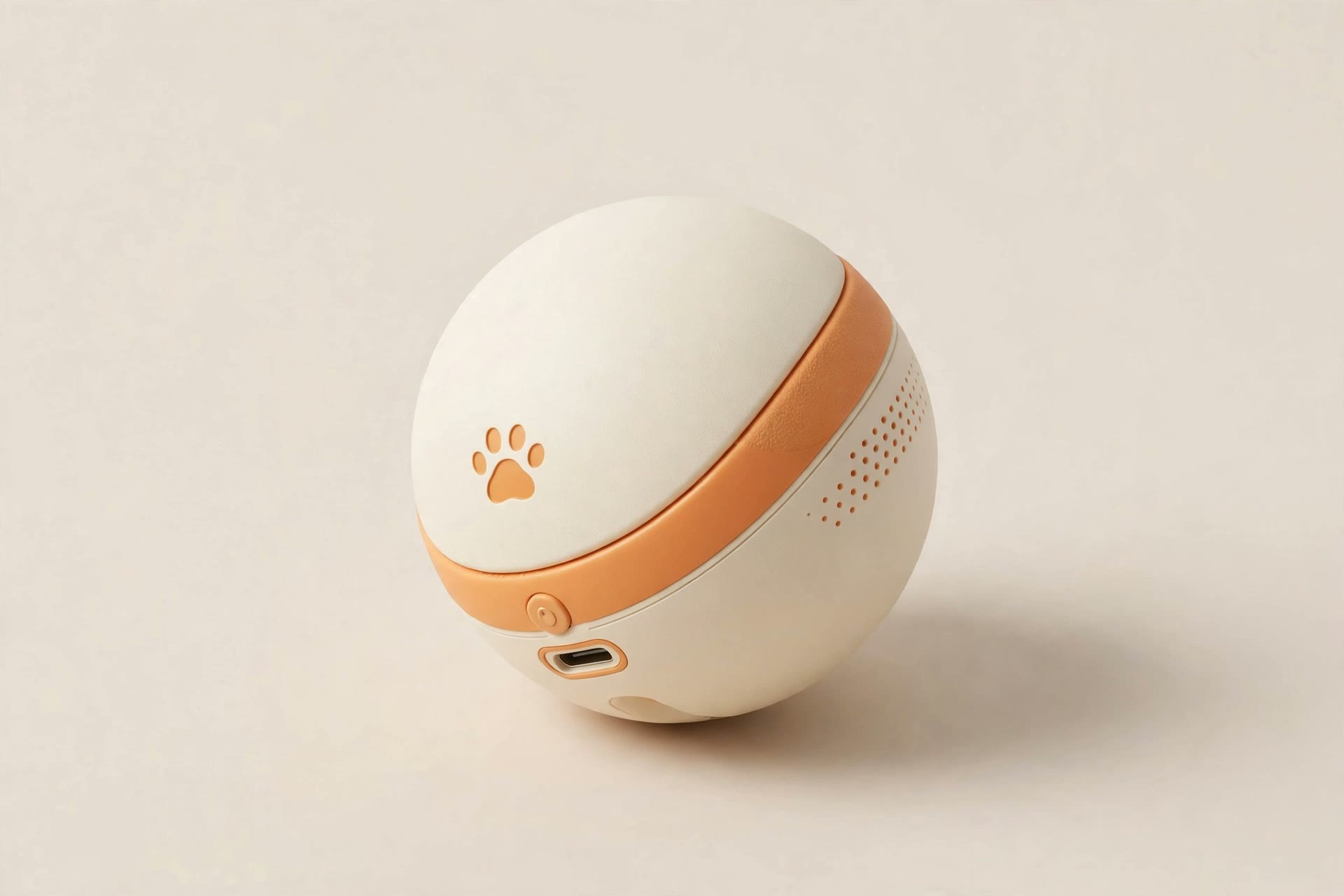
The Zoomie Ball is a 7 cm, 85-gram ball that rolls, pauses, spins and darts entirely on its own. The movement is deliberately unpredictable — darting, freezing, changing direction without warning — which is exactly what flips a cat’s hunting switch. Mine went from couch potato to ambush predator in about four minutes flat. I watched it on the pet cam from the office and nearly missed my standup meeting.
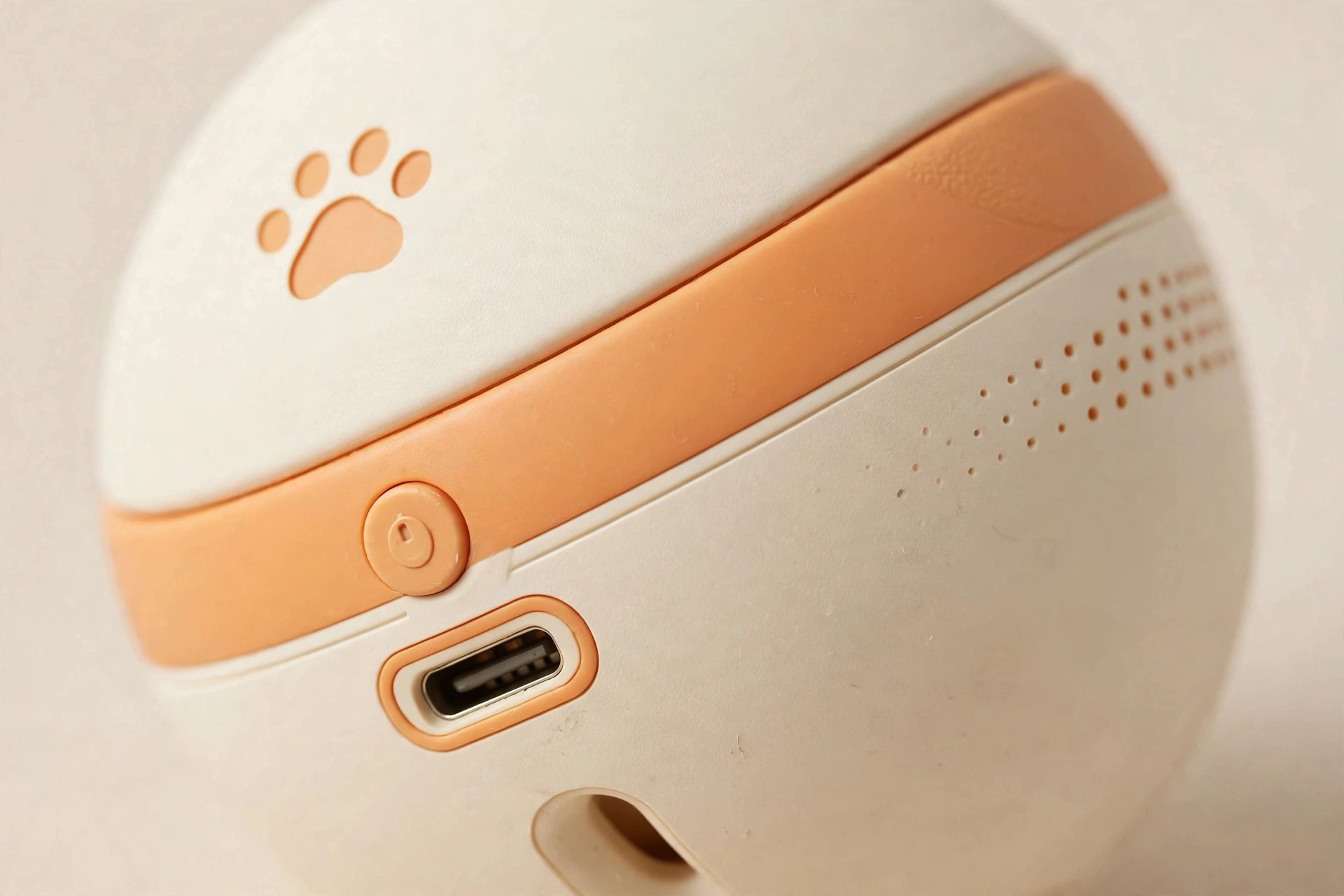
Three speed modes cover kittens, adults and seniors, so you’re not launching a rocket at a nervous rescue on day one. The part I didn’t expect: it’s genuinely quiet. Under 40 decibels — quieter than my fridge hum — so I leave it running when I work from home and it doesn’t drive me insane. One full charge (about an hour on the included USB-C cable) gives roughly two hours of play. It auto-sleeps after five idle minutes and wakes the second a paw touches it, so the battery isn’t dead by noon. The obstacle-avoidance sensor turns it away from walls and furniture on its own.
Safety-wise it’s a seamless ABS shell — no small parts to chew off — non-toxic and BPA-free. Wipe it with a damp cloth now and then; just don’t submerge it.
2. Somewhere to scratch and crash
The other half of the equation. A bored cat scratches — it’s stress relief, claw maintenance and territory marking rolled into one. Yelling doesn’t stop it. Giving them something better to scratch does.
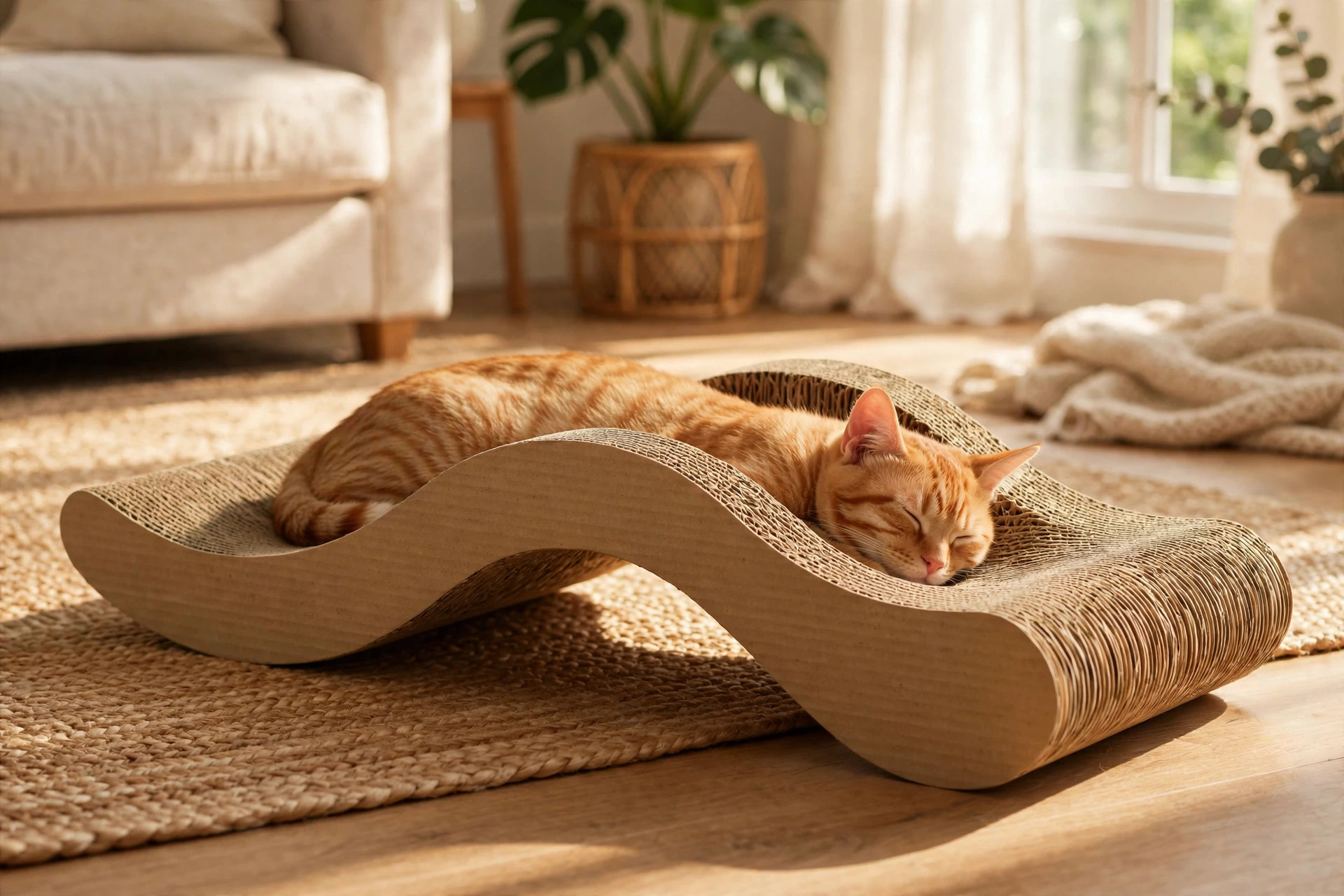
The Scratch & Snooze is a curved cardboard lounge: scratcher on the outside, nap spot on the inside. Two jobs, one footprint. The curve follows the way cats actually curl up, and mine claimed it as a bed within an hour — the included catnip pouch probably helped with the introduction. It’s reversible, so when one side gets shredded you flip it over for a fresh surface. That honestly doubles how long it lasts. The high-density honeycomb cardboard stands up to months of daily scratching; when it’s finally confetti, you recycle it and get another.
Two sizes: the standard 50 × 25 × 12 cm fits cats up to 5 kg, the large 65 × 30 × 14 cm goes up to 8 kg. Recycled cardboard, non-toxic glue. Vacuum the crumbs out occasionally and you’re done.
3. The free one: ten minutes before you leave
This costs nothing and I’d argue it matters most. Ten minutes of real play right before you head out — wand toy, get them panting, stop when the mouth opens. It takes the edge off their energy so the morning isn’t just pacing and waiting.
Quick question — have you ever actually counted how many hours your cat is awake and alone? Most of us haven’t. We just assume the nap covers it. It doesn’t, quite. But the fix isn’t complicated: something that moves on its own, somewhere that’s theirs to destroy, and ten minutes of your morning.
My current setup: Zoomie Ball on the living room floor before I leave, Scratch & Snooze by the window where the afternoon sun lands. The 3 a.m. bookshelf parkour? Down to maybe once a week. I’ll take it.
Shop the products in this article:
Zoomie Ball – Interactive Self-Rolling Cat Toy
Scratch & Snooze – Cardboard Scratcher Lounge
Dog Won’t Sleep in Its New Bed? 6 Reasons and Fixes That Actually Work
My dog Biscuit has strong opinions about furniture. Two years ago I spent $120 on a “luxury orthopedic” dog bed — the kind with a thousand five-star reviews — and she looked at it once, then went back to sleeping on the cold tile next to my desk. For three weeks. The bed sat there like an expensive ottoman while she snored on the floor two feet away.
Sound familiar? You’re not alone, and your dog isn’t broken. A new bed fails for specific, fixable reasons. Here are the six I see most — and what actually works, from someone who has bought four beds for one very stubborn beagle.
1. It smells like a factory, not like home
Dogs live by their noses. A brand-new bed smells like plastic wrap, warehouse dust, and whatever the delivery truck smelled like. To you it’s “new.” To your dog it’s suspicious.
Fix: wash it first. If the cover is removable and machine washable, run it through a normal cycle before the bed ever touches your floor. Then — this is the part that actually matters — sleep with an old t-shirt for two nights and lay it on the bed. Your smell is the fastest “this is safe” signal there is. Biscuit claimed her bed within 48 hours of the t-shirt trick, after ignoring it for three weeks.
2. You put it in the wrong spot
We tend to place dog beds where they look nice: the corner of the bedroom, the laundry room, that awkward nook under the stairs. Dogs don’t care about your interior design. They sleep where the pack sleeps.
If your dog follows you from room to room all day and then won’t use the bed you put in the spare room — that’s not a bed problem, that’s a location problem. Move it to wherever you spend your evenings. Yes, even if it clashes with the rug.
3. The shape fights how your dog actually sleeps
Watch your dog sleep for two nights. Really watch. Does she curl into a tight ball, nose tucked under tail? Or does he sprawl flat on his side, legs sticking straight out like he’s been dropped from a height?
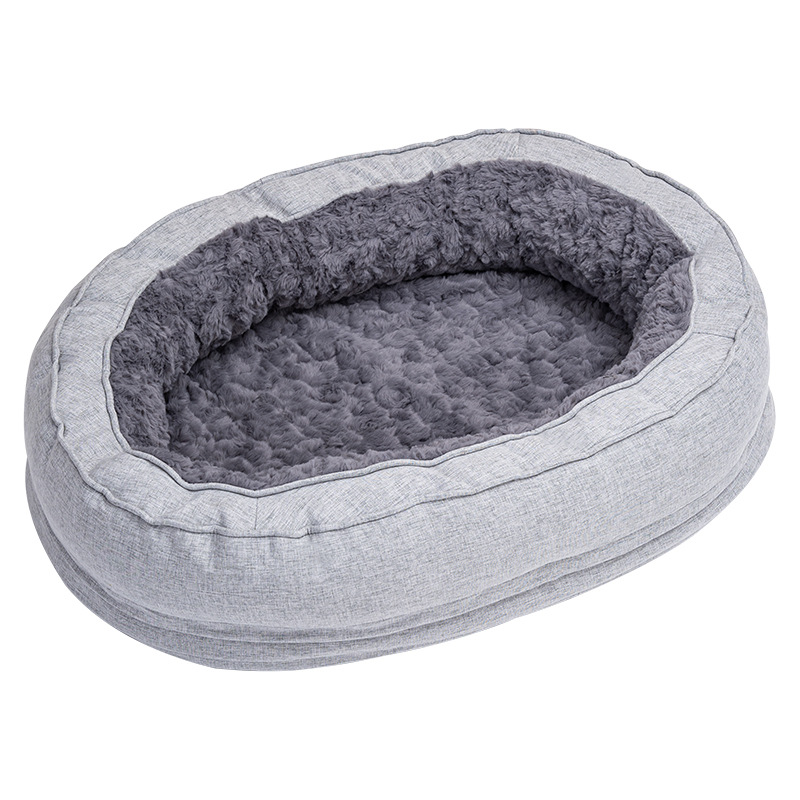
Curlers want walls. A donut-style bed with a raised rim — like our Cloud Donut Calming Bed — gives them something to burrow against, and the plush rim doubles as a chin rest. The raised edge also genuinely helps anxious dogs settle; the “hug” effect isn’t just marketing.
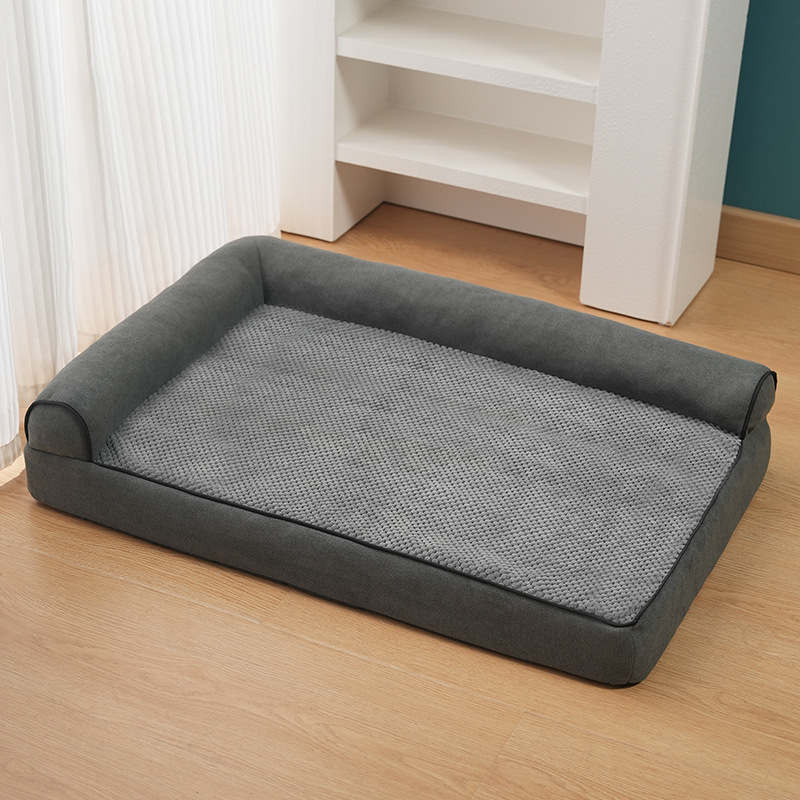
Sprawlers and leaners are the opposite: they want a flat, supportive surface with maybe one bolster to drape over, like the arm of your couch. That’s exactly why the Bolster Sofa Dog Bed exists — memory foam base, L-shaped cushion, built for dogs who treat your sofa like their personal throne. If your dog’s favorite “bed” is currently your couch cushions, stop fighting it and give them their own couch.
4. It’s the wrong temperature
Thick faux-fur beds are wonderful in January and miserable in July. Dogs can’t take off a sweater — if the bed sleeps hot, they’ll choose the tile every time, and no amount of treats will change their mind.
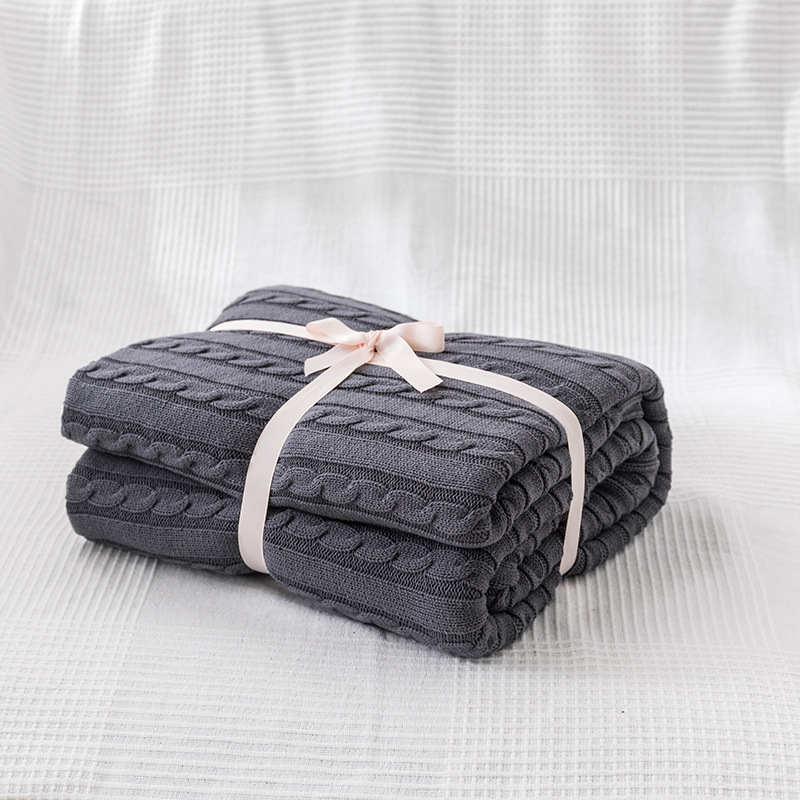
You don’t need a summer bed and a winter bed. You need one bed and a layer you can add or take away. A breathable cotton throw — our Cable Knit Throw Blanket is literally made for this — turns any bed into a winter bed in October and comes off in May. Cheaper than buying two beds, and the blanket works on your sofa too.
5. It’s just… new and weird
Some dogs are neophobic — new things are guilty until proven innocent. A bed that appeared overnight is, in dog logic, a suspicious object that might eat them.
Give it three days minimum before you declare failure. Put treats on the bed (not in it — on it), feed a meal or two next to it, and let the dog investigate on their own schedule. Don’t pick the dog up and place them in it. Nothing says “trap” like being deposited into a strange padded pit by a giant.
6. Honestly? The old spot is just better
Sometimes the answer is uncomfortable: your dog prefers the couch because the couch is objectively nicer. Higher, softer, smells like you, great view of the front door.
Here’s my unpopular opinion: don’t buy three different beds hoping one sticks. That’s how you end up with a closet full of rejected beds (ask me how I know — four). Buy ONE bed that matches how your dog actually sleeps, put it where you actually hang out, make it smell like you, and give it a week. If that doesn’t work, the problem was never the bed.
The short version
Wash it. Move it near you. Match the shape to the sleeper. Control the temperature with a throw. Give it three days. And buy for the dog you have — the floor-sleeper, the couch-thief, the nervous circler — not the dog in the product photo.
Biscuit now sleeps in her donut bed every single night. It took a t-shirt, a new spot by the sofa, and swallowing my pride about the $120 orthopedic one (donated to the shelter, where a very happy labrador uses it daily). The right bed isn’t the most expensive one. It’s the one your dog will actually sleep in.
Shop this article
- Cloud Donut Calming Bed — raised plush rim for curlers and anxious sleepers, machine washable
- Bolster Sofa Dog Bed — memory-foam sofa-style bed for sprawlers and couch loyalists
- Cable Knit Throw Blanket — breathable cotton layer for temperature control
Why Your Cat Gets Bored of Teaser Wands in 3 Minutes
First, the truth: it’s not your cat. It’s your technique.
My orange tabby, DouBao, has a half-full box of teaser wands I’ve bought him. His response? A glance, a sniff, and he walks away. The longest session ever lasted maybe 3 minutes — and that was only because I dangled a feather right under his nose and he swatted at it out of pity.
I used to think I was buying the wrong toys. Then one day I watched him chase a moth that flew into the apartment. Twenty minutes. Full speed, eyes locked on. That’s when it clicked: the toy isn’t the problem. The way I play is.

Cats hunt on “almost got it”
Cats are ambush predators. In the wild, they spend 80% of their time watching and waiting — the actual pounce is one explosive moment. A feather waved lazily in front of their face? That’s basically a dead animal. Boring.
What hooks a cat is uncertainty. The feather appears, disappears, speeds up, slows down. “Almost got it” — that’s the drug. Your cat chases that moth for 20 minutes because the moth is always just out of reach.
So stop drawing circles in your cat’s face. Try these three instead:
1. The peek-a-boo. Hide the feather behind the couch, let just the tip show, twitch it. Your cat will crouch low, butt wiggling side to side — that’s hunting mode. Then let the feather “escape.” Pounce guaranteed.
2. Fast-slow-fast. Jerk it fast for 5 seconds, freeze for 3, then drag slowly. The freeze is the killer moment — your cat has no idea where the “prey” goes next.
3. Let them win. 10-15 minutes is plenty. Always end with a successful catch, then a small treat. Hunt → eat → groom → sleep. That’s the natural feline cycle, and behaviorists confirm it calms them down for hours.
What makes a teaser wand worth buying? Honest take.
First, the feathers. Cheap ones shed like crazy — DouBao once swallowed a small feather and I spent midnight googling emergency vets. Look for tightly bound natural feathers — turkey and guinea fowl feathers have great texture and don’t fall apart. And put the wand away after play. Don’t leave it on the floor for unsupervised chewing.
Then the rod. A stiff rod moves like a stick — no cat is fooled by that. A flexible fiberglass rod whips the feathers through the air like a real bird in flight. That’s what gets them chasing. The cord should be long too, around 90 cm, keeping your hands safely away from claws.
About the bell — let’s be fair
People always ask: is the bell on a teaser wand good or bad? Honestly? It depends on the cat.
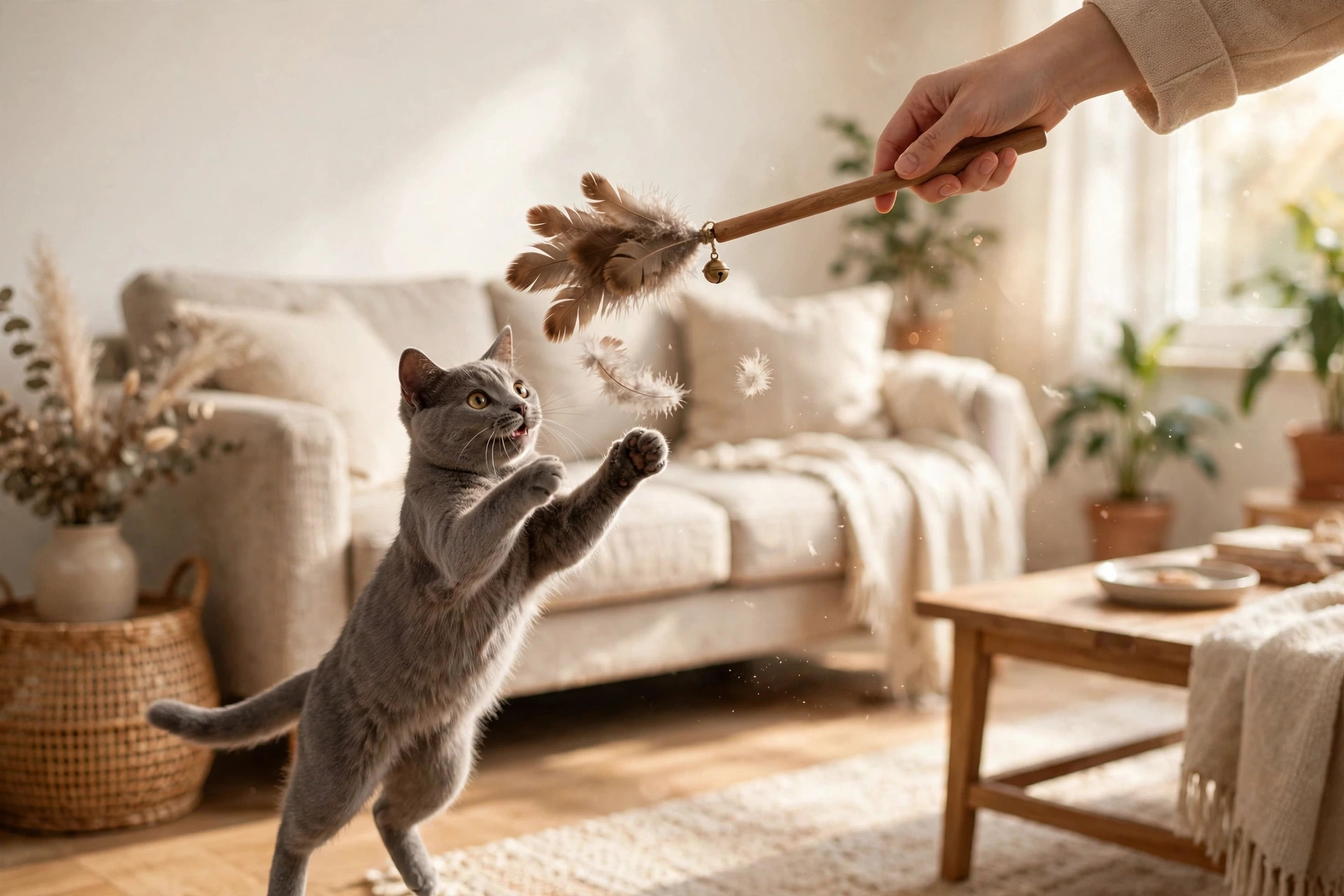
Bold cats love it — the jingle grabs their attention before they even see the feathers, perfect for those aloof types who ignore everything. But timid cats can get startled by the sudden sound and dive straight under the bed.
So the real question isn’t “bell or no bell.” It’s “can you take the bell off?” Our Flutter Wand comes with a detachable bell: if your cat likes the sound, keep it on. If your cat flinches, pop it off in one second. Let your cat’s reaction decide — that’s the only sensible approach.
Does your cat do this too?
If yours ignores the teaser wand, don’t rush to buy a new one. Change your technique for a week — you’ll probably be surprised. And if that still doesn’t work? Then your cat might just be… genuinely lazy. My advice: give up, buy a scratching post as decoration. It’ll look nice.
One more thing: 15 minutes of play at the same time every day, keep it up for two weeks, and those 4 AM zoomies will drop dramatically. Don’t ask how I know. Let’s just say DouBao stepping on my face at dawn taught me well.
Featured in this article: Flutter Wand – Feather Teaser (natural feathers / detachable bell / 90cm cord), Zoomie Ball – Interactive Cat Toy
Stop the Pull: How to Choose the Right Leash for Loose-Leash Walking
Every dog owner knows the feeling: one squirrel, one interesting smell, and suddenly your shoulder is doing all the talking. A good walk should be the best part of your day — not a daily tug-of-war. The good news? The fix is simpler than most people think. It comes down to two things: the right gear, and a handful of training habits that actually stick.
First, understand why dogs pull
Dogs aren’t pulling to dominate you — they’re pulling because it works. There’s also a built-in reflex at play: the opposition reflex. Push against a dog, and its instinct is to push back. So a constantly tight leash literally trains your dog to pull harder.
Add excitement, an under-exercised body, and the fact that every time you follow a pulling dog it gets exactly where it wanted to go, and you have a habit that reinforces itself on every walk. Break the cycle, and everything gets easier.
It also helps to reframe what the leash is for. A leash is a safety line and a communication channel — not a steering wheel. If you find yourself constantly hauling your dog back into position, the equipment or the training (usually both) needs a rethink, not your biceps.
The three leash types (and when to use each)
Not all leashes do the same job. Here’s the honest breakdown:
1. The standard flat leash (1.2–1.8 m)
The everyday default, and the best tool for training. Simple, predictable, and it keeps communication between you and your dog clear. If you only own one leash, make it this one.
2. The training / no-pull leash
Built for dogs that are still learning. The key feature is a second “traffic” handle near the clip — it lets you bring your dog close in an instant around traffic, other dogs, or crowded sidewalks, without wrapping the leash around your hand. A padded main handle saves your palm on longer walks.
3. The retractable leash
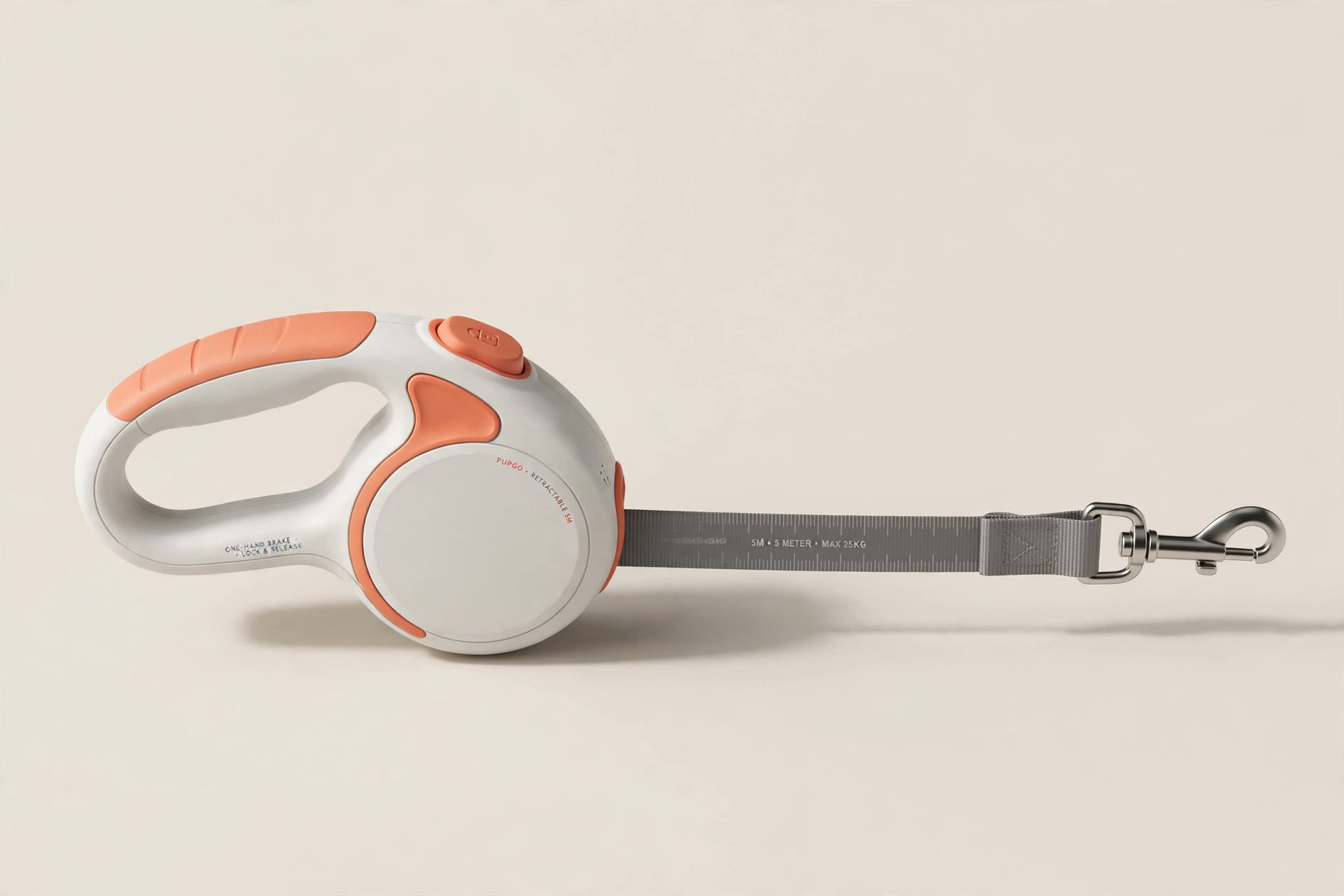
Great for open spaces where your dog can safely roam and sniff — a 5-metre line turns a boring lawn into a proper sniffari. But it’s the wrong tool for training loose-leash walking or for busy streets, where a long line is a tripping hazard. Use it where it belongs: parks, fields, and quiet trails.
Collar vs. harness: what pullers should wear
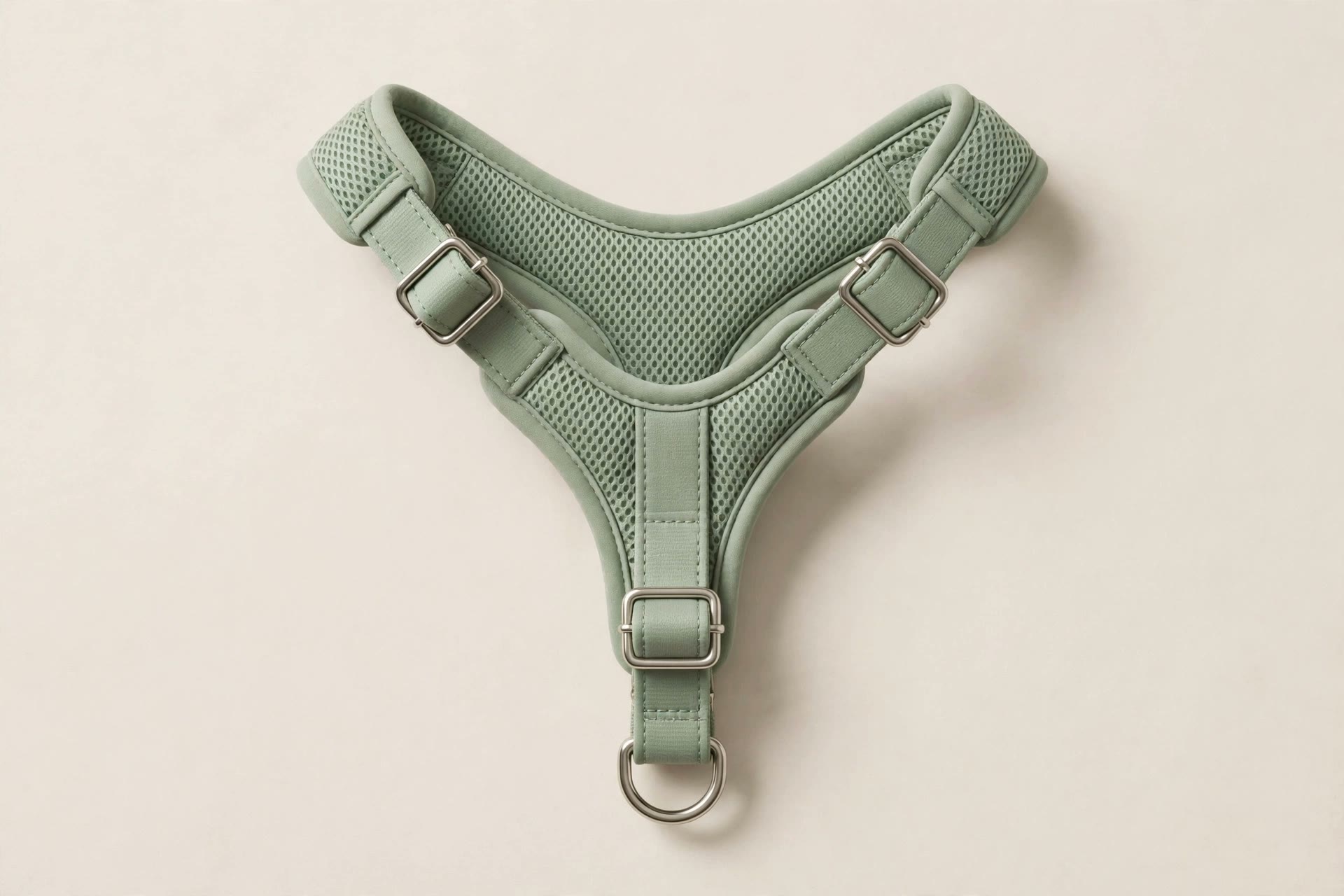
If your dog pulls, a Y-shaped harness beats a collar every time. A collar puts all the force on the throat; a well-fitted Y-harness distributes it across the chest and shoulders, gives you steering control without choking, and keeps the leash attachment at the back where it can’t tangle the front legs. Look for adjustable straps at the neck and chest, and soft padding where it sits against the body.
What to look for when buying a leash
Walk into any pet store and the wall of leashes is overwhelming. Ignore the patterns and focus on these five things:
- Length: around 1.5 m is the sweet spot for city walks; 3–5 m for relaxed sniff walks.
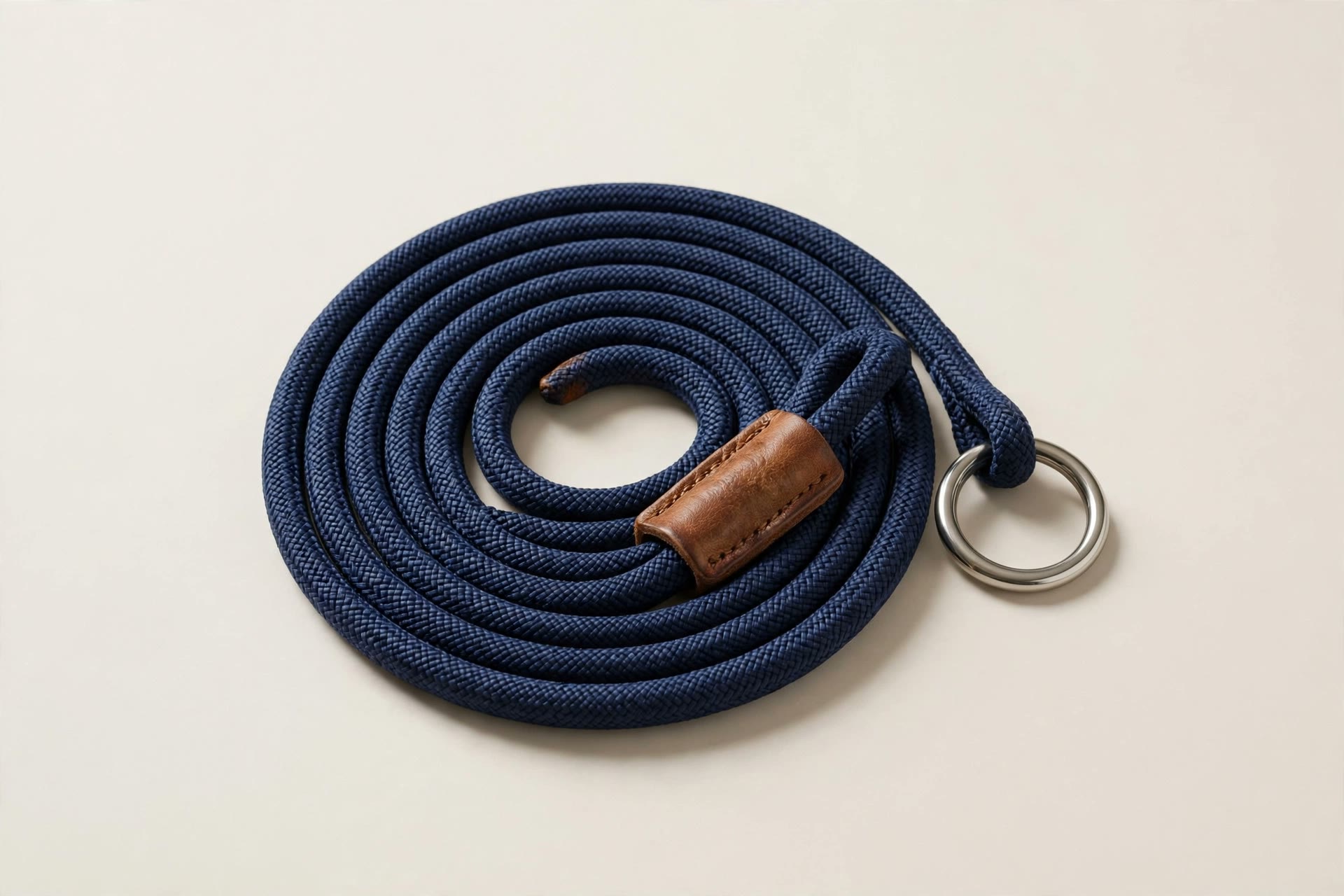
- Width and material: match the leash to your dog’s size and strength — sturdy nylon or climbing-rope style webbing for strong pullers.
- Handles: a padded main handle plus a traffic handle near the clip.
- Hardware: a swivel snap that won’t twist, and a clasp rated for your dog’s weight.
- Visibility: reflective stitching is a small detail that matters a lot on night walks.
5 training tips that actually work
1. Be a tree. The instant the leash goes tight, stop dead. The walk only continues on a loose leash. Boring for the dog — which is exactly the point.
2. Reward the slack. In the early days, treat every few steps of loose-leash walking. You’re paying for the behaviour you want, generously, before asking for more. Keep treats in a pouch on your walking side so the reward lands exactly where you want the dog — next to you, not out front.
3. Change direction. Dog surges ahead? Calmly turn and walk the other way. Pulling stops predicting “forward” and starts predicting “oops, wrong way”.
4. Train a little tired. A five-minute play session before the walk takes the edge off and makes learning dramatically easier.
5. Keep sessions short. Five to ten focused minutes beat a frustrated half hour. Always end on a win.
None of this requires special talent — just consistency for a week or two. Most owners see a real difference within days.
Gear up for better walks
The right equipment won’t train your dog for you, but it removes every excuse. Here’s our Walk collection:
- Steady-Pull Training Leash — dual handles including a traffic handle, padded grip, reflective stitching. Our pick for dogs in training.
- Comfy-Y Harness — Y-shaped, no throat pressure, fully adjustable with soft padding.
- Roam Retractable Leash (5 m) — smooth brake and lock for safe sniffaris in open spaces.
Walks are the highlight of your dog’s day. Make them the highlight of yours too.