Just Adopted a Rescue Dog? The 3-3-3 Rule and the First-Three-Weeks Setup That Actually Helps Them Settle
The first 48 hours, he lived under my coffee table. Wouldn’t take a treat from my hand, flinched at the TV, and peed on the rug at 3 a.m. like he’d never been outside in his life.
He had, of course. The shelter paperwork said “house-trained, good with people.” Both things were true — just not on day one. If you just brought a rescue dog home and you’re wondering whether you made a terrible mistake, you didn’t. You’re just in the part nobody warns you about.
The 3-3-3 rule: what the shelter volunteer should have told you
Rescue folks repeat it like a mantra: 3 days, 3 weeks, 3 months.
The first 3 days, your dog is overwhelmed. Shut down is the default setting — not eating much, hiding, startling at normal household sounds. This isn’t their personality. This is a dog running on fumes, trying to figure out if this new place is safe.
The first 3 weeks, they start settling in — and testing you. Appetite comes back, the goofy starts leaking out, and so do the boundaries: counter-surfing, selective hearing, chewing something you liked. This is the phase where most adopters panic. “He was an angel at the shelter and now he’s eating my doorframe!” Relax. A dog only misbehaves in a place it already feels safe enough to be a dog in. That’s progress wearing a disguise.
The first 3 months, they’re home. Real trust, real routine, real personality — the dog you actually adopted finally shows up.
Knowing the timeline doesn’t make week one easy. But it stops you from trying to fix things that aren’t broken.
Week one: less is more
Almost every mistake I see new adopters make is a version of too much, too soon:
- Don’t throw a welcome party. Your friends can meet him in month two. In week one, every new human is a pop quiz he didn’t study for.
- Don’t take him to the dog park “to make friends.” He’s already at maximum input. A chaotic off-leash park on day four is how you get a bite incident and a returned dog.
- Don’t buy a mountain of toys. A shut-down dog will ignore toys for days — sometimes a full week. One soft toy is plenty for now. The 12-pack of squeakers can wait until you know what he actually likes.
- Don’t take hiding personally. Under the table is a strategy, not an insult. Let him come out on his schedule, not yours.
Give them one small world, not the whole house
Here’s the thing most setup guides miss: a new dog doesn’t want your whole house. They want one safe corner they fully understand. Dogs settle fastest when they have a den — a defined spot, ideally with something solid on at least one side, where nothing surprising ever happens.
Pick a quiet corner, put down a bed, and make it law: that bed is the dog’s embassy. Nobody bothers them there. Kids, guests, the cat — the bed is sovereign territory.
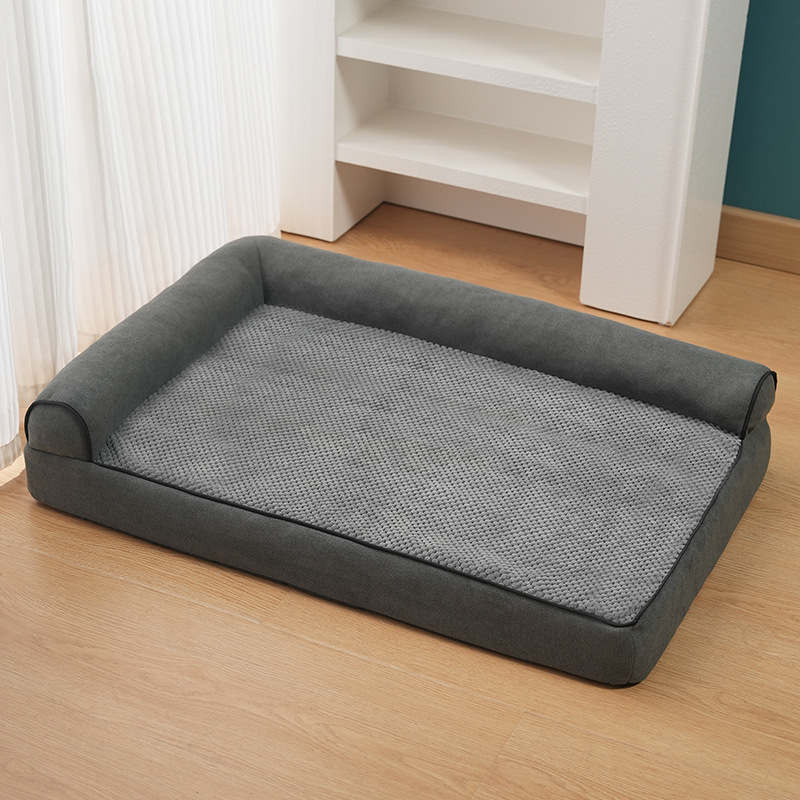
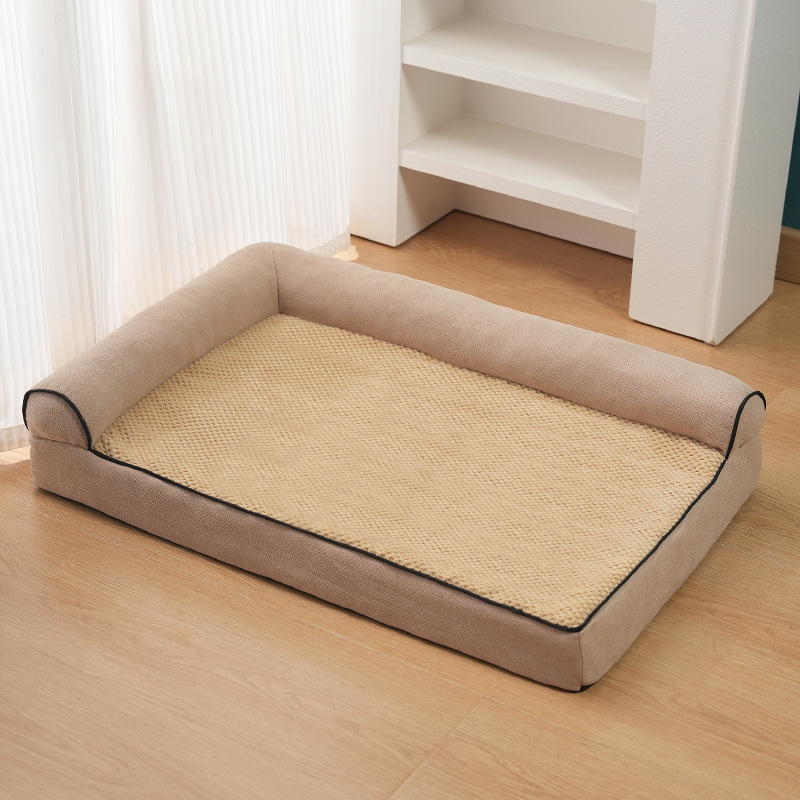
What works as the embassy: a bed with actual structure. I’ve become a believer in bolster-style beds for new rescues, because the raised edge does the job of a den wall — the dog can press its back against something, lean, sprawl, or curl up nose-to-tail. The Bolster Sofa Dog Bed is built exactly like that: L-shaped cushion, memory-foam base, shaped so a nervous dog can wedge itself into the corner and finally exhale.
Two practical notes from someone who learned the hard way. First: buy the washable one. Week-one accidents are normal — my guy’s 3 a.m. rug incident was not his last surprise. A bed with a removable, machine-washable cover isn’t a luxury feature; it’s the whole plan. Second: don’t size up “to be safe.” An XXL bed that swallows a 15 kg dog doesn’t feel like a den, it feels like a parking lot. Snug wins.
Cheap trick that actually works: put a worn t-shirt of yours on the bed. Your smell becomes part of the safe place. Costs nothing, beats every $30 “calming” spray on the shelf — and yes, I’m telling you the spray isn’t worth buying.
Decompression walks beat the dog park (for now)
Forget exercise quotas in week one. What a new rescue needs is decompression: 15–20 minutes on a quiet route, same streets each day, and one rule — the dog’s nose sets the pace. Sniffing is how dogs download a new neighborhood. A twenty-minute sniff walk tires a stressed dog out more honestly than an hour of forced marching.
Gear matters here more than people think. You want a leash you can slip on without wrestling buckles onto a nervous dog, with enough length to let them range and sniff, but real control when a skateboard appears out of nowhere. I’ve been using a slip-style lead for this: the Steady-Pull Training Leash comes in 1.5 m for city streets and 3 m for open spaces — I keep the 3 m for decompression walks, where those extra meters are the difference between “held tight” and “free to be a dog.” The leather stop toggle is the part I care about: when a new rescue panic-pulls (and they will), the loop can’t cinch down into a choke. One motion on, no hardware to fumble with cold hands at 6 a.m.
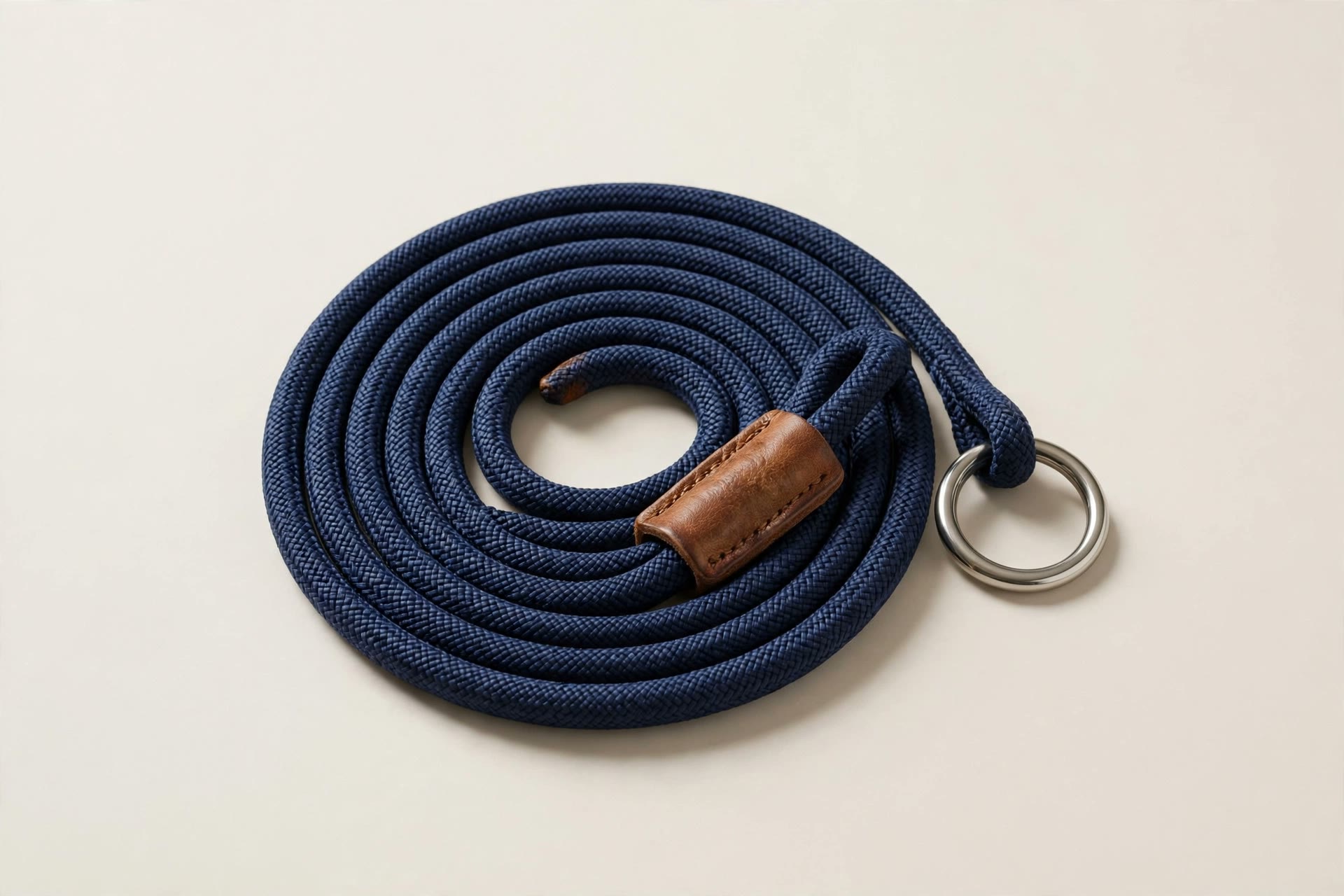
Two safety notes, because slip leads demand respect: keep the ring positioned behind the ears where you actually have steering, and never leave a slip leash on an unsupervised dog — it’s a walking tool, not a collar, not a tie-out. And please: no matter how soulful the eyes get, do not go off-leash in week one. A dog that doesn’t know where home is yet doesn’t come back. That’s not pessimism, that’s physics.
What weeks two and three actually look like
Around day 10, something shifts. Appetite normalizes. The tail starts doing that helicopter thing. You’ll get the first play bow — usually aimed at absolutely nothing — and you’ll feel like crying a little. Totally normal.
This is also when the boundary-testing starts in earnest, which is your cue to begin, gently: five-minute training sessions (the 3 m lead is perfect for recall practice in an empty field), one new room of the house at a time, and the first real vet visit if you haven’t done it yet. Short, boring, consistent. Dogs find boring deeply reassuring.
By month three, you’ll look at the dog asleep upside-down on the couch — your couch, obviously, the embassy treaty expired weeks ago — and barely remember the coffee-table era.
The two things I’d buy before pickup day
If I could hand every new adopter a starter kit, it would be embarrassingly short: a structured, washable bed that works as a den from night one, and a slip lead with a real stop for calm decompression walks. Everything else — the toy mountain, the fancy treats, the second bed for the bedroom — can wait until you know the dog. The 3-3-3 rule handles the rest.
My Cat Got Fat. The Vet Said “Move More” — Here’s the Indoor Exercise Plan That Actually Worked
The vet weighed my cat, looked at the number, looked at my cat, and said: “6.2 kilos. He should be 4.5, maybe 5. At this rate he won’t be jumping onto the sofa in a year.”
My cat, to his credit, sat on the exam table shaped like a dinner roll and pretended this had nothing to do with him.
On the drive home I did the math nobody wants to do. An overweight indoor cat isn’t just “chubby and cute.” It’s joints grinding under extra load. It’s diabetes risk. It’s a shorter life, full stop. And the standard advice — feed less — only got me a cat who screamed at 3 a.m. next to an empty bowl and then stole food off the counter.
Here’s the part nobody tells you: you can’t walk a cat like a dog to burn it off. Well, technically you can harness-train one, but try explaining cardio to an animal whose entire philosophy is “why run when I can nap.” Exercise for an indoor cat has to be tricked into happening. It has to feel like hunting, not working out.
So I built a plan around three things. Six weeks later: 6.2 to 5.7 kilos. The vet actually nodded.
1. The automatic workout: a ball that hunts back
I work full days. Telling myself I’d play with the cat every evening lasted exactly four days. I needed something that worked while I wasn’t there.
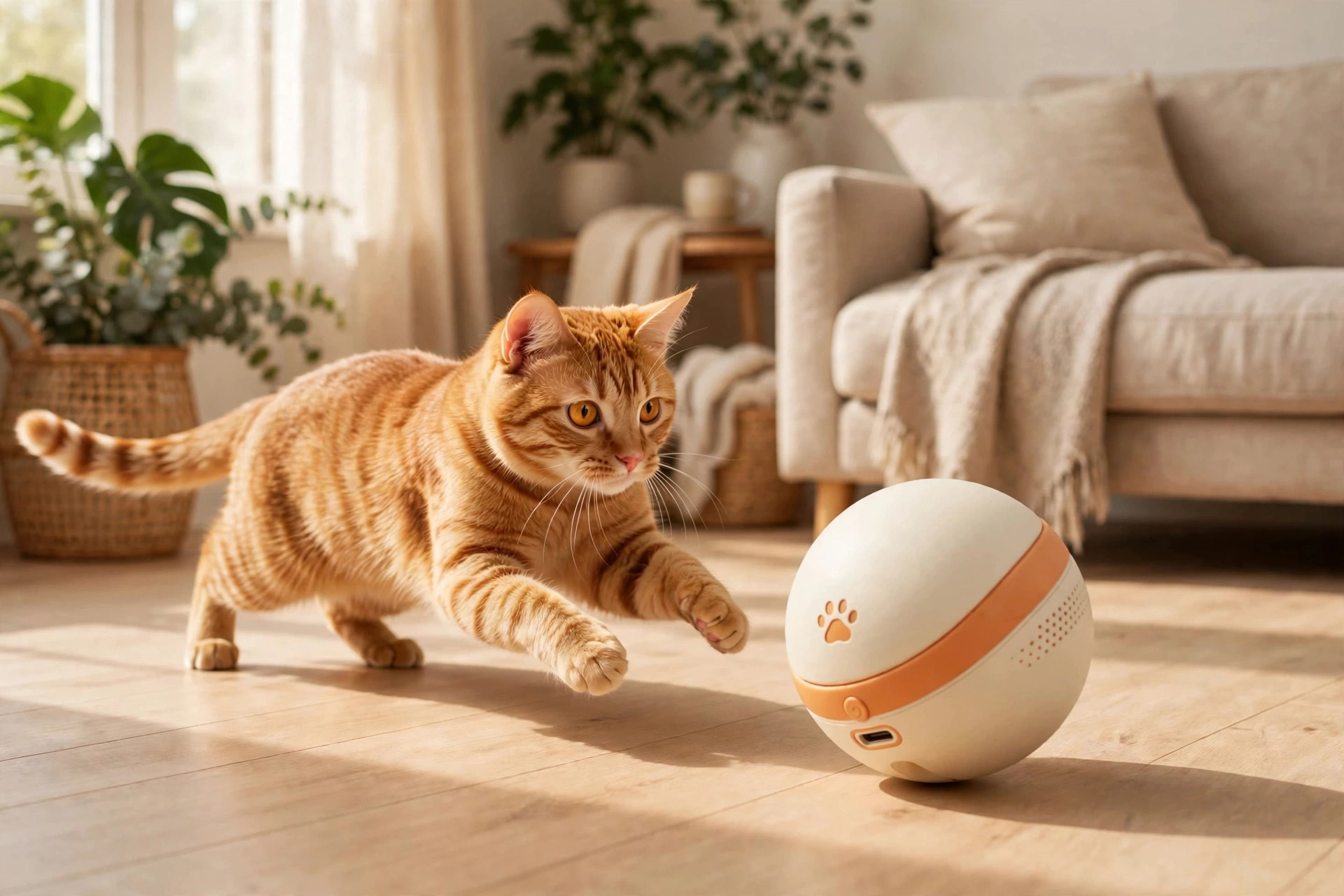
The Zoomie Ball is a self-rolling smart ball — 7 cm across, 85 grams, with three speed settings and a motor under 40 decibels. It darts, pauses, spins, changes direction on its own, mimicking prey. Two hours of play per charge, one hour to recharge, and if the cat ignores it for five minutes it naps and wakes the second it’s touched. Obstacle sensors keep it from getting stuck under the fridge.
Day one, my cat was terrified of it. Hid under the sofa. Day two, he batted it once and jumped back. Day three, I came home to a cat panting next to a ball that had rolled itself under the coffee table — the feline equivalent of collapsing on the gym floor.
My honest take: it’s not a babysitter, and the marketing that implies you can just switch it on and leave is overselling it. Where it actually shines is the 20 minutes before bed. I turn it on while I brush my teeth. He gets his zoomies out. Then he sleeps through the night instead of parkouring off my face at 4 a.m. That alone was worth it.
2. The hunt sequence: ten minutes with a feather wand
The ball handles solo exercise. But a cat’s brain needs the full hunt — stalk, chase, catch, eat. Skip the catch and you get a frustrated cat. That’s exactly why I tell people not to bother with laser pointers: the cat can never catch the dot, and it’s the equivalent of teasing someone with food they can never eat. Cruel, not fun.
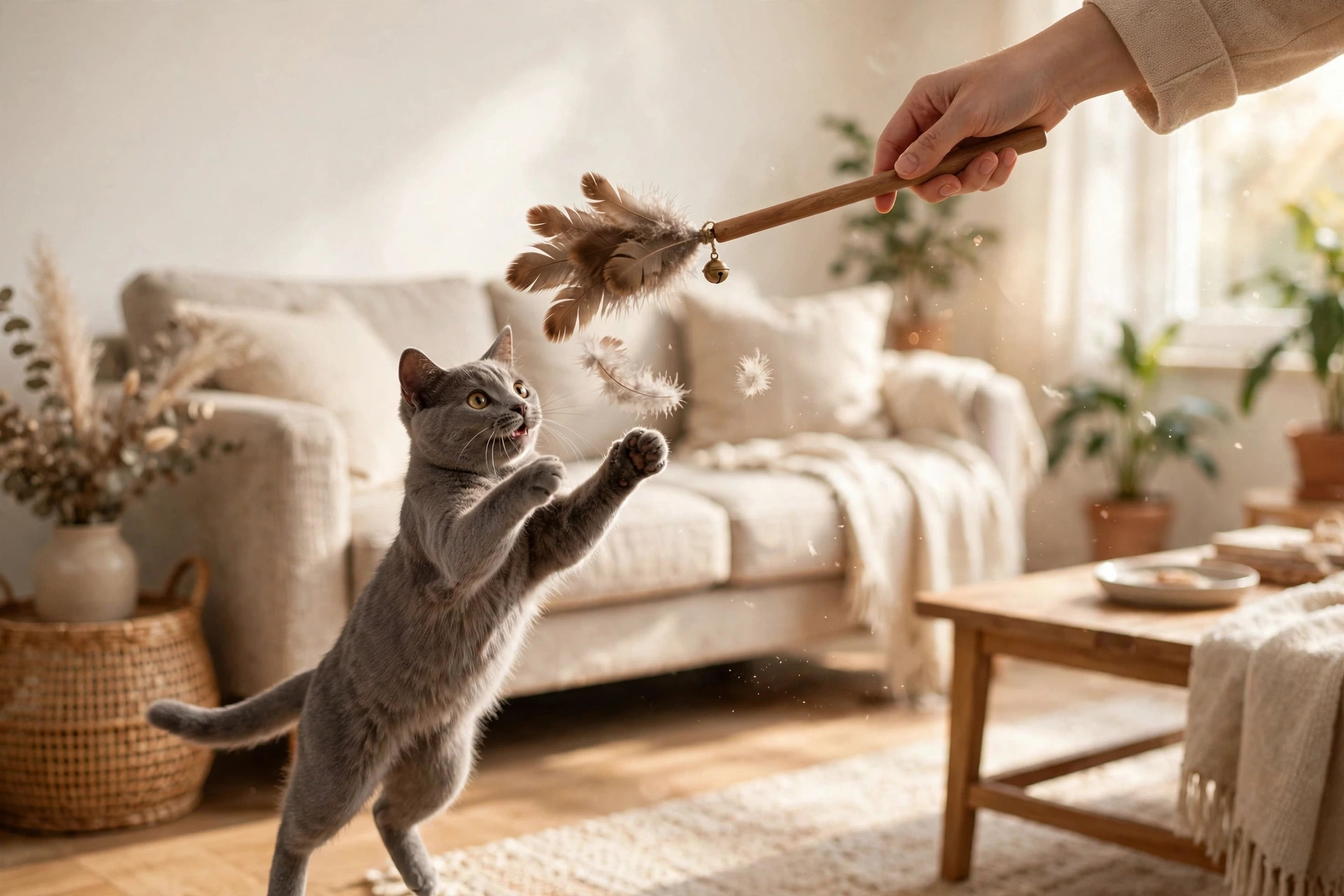
The Flutter Wand does the job properly. Real turkey and guinea fowl feathers, a flexible fiberglass rod that whips like a bird in flight, and a 90 cm cord that keeps your fingers far from claws. The feather head quick-swaps when it gets shredded, which it will.
My routine, ten minutes, once a day:
- Two minutes slow — drag the feathers along the floor like something sneaking.
- Five minutes fast — sudden direction changes, over the sofa arm, behind the chair leg. Let him sprint.
- Three minutes cool-down — slow it down and LET HIM CATCH IT. This is the part most people skip. Then a small treat immediately after. Hunt, catch, eat. That’s the sequence his brain is wired for.
Ten minutes. That’s shorter than scrolling your phone on the toilet. And a cat that just “killed” something doesn’t beg for snacks at midnight — the hunt is over, the belly is satisfied, the brain clocks out.
3. The warm-up station: a scratcher a fat cat will actually use
Here’s something the fitness influencers of the cat world never mention: an overweight cat can’t use half the “exercise” furniture sold for cats. Those tall sisal towers? My 6.2-kilo boy looked at the 1.5-meter tower, looked at me, and the message was clear: absolutely not.
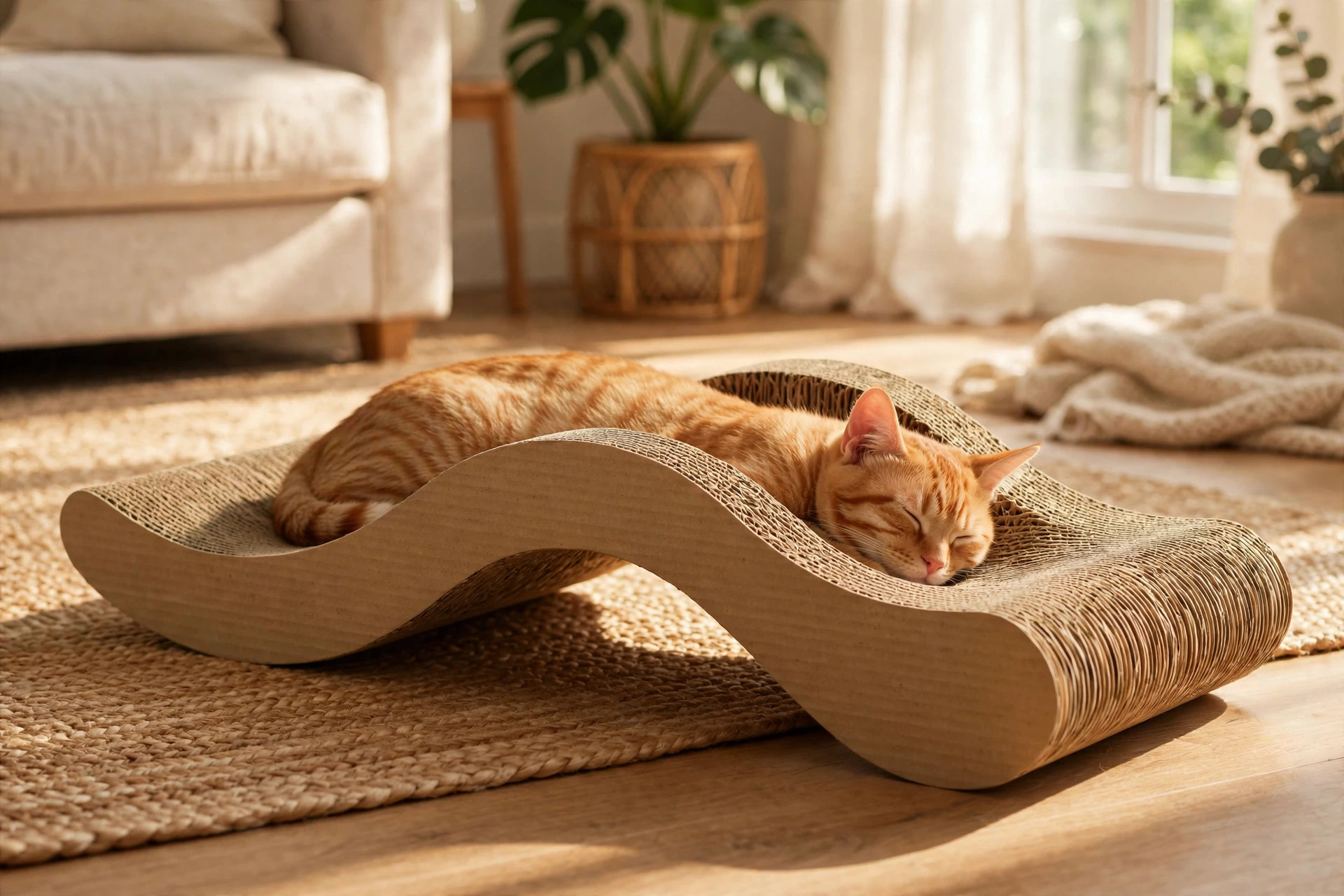
The Scratch & Snooze is a curved cardboard lounge — scratcher and bed in one, sitting low to the ground. High-density honeycomb cardboard, reversible for double the lifespan, and it comes with catnip. I sprinkled a pinch on it. He climbed on, scratched, stretched his whole spine out along the curve, and fell asleep mid-stretch. Exercise, stretching, nap — the holy trinity, without moving an inch.
Don’t underestimate scratching as exercise, by the way. A proper full-body scratch-and-stretch engages the shoulders, back, and hind legs. It’s the cat version of morning yoga, except the cat actually does it.
What actually changed
Six weeks. Ball on every evening, wand play daily, scratcher always available. Food measured, not eyeballed — that part matters, I’m not pretending toys alone did it. 6.2 kilos down to 5.7. The vet weighed him, raised an eyebrow, and said “whatever you’re doing, keep doing it.”
The part I didn’t expect: he’s more fun now. A fit cat is a playful cat. He initiates games. He does the sideways crab-walk down the hallway. The dinner-roll cat is gone, and honestly, so is some of my guilt.
When’s the last time your cat really ran? Not trotted to the food bowl — ran, full sprint, ears back? If you can’t remember, that’s your answer. Start tonight. Ten minutes and a feather wand is all it takes to begin.
The gear that made it work:
- Zoomie Ball – Interactive Cat Toy — the automatic workout while you’re out
- Flutter Wand – Feather Teaser — the ten-minute hunt sequence
- Scratch & Snooze – Cardboard Lounge — the low, fat-cat-friendly scratcher
Why Your Dog Destroys Every Bed (and How to Pick One That Actually Survives)
My beagle mix, Biscuit, destroyed three dog beds in two months. Not chewed a corner — destroyed. Fluff everywhere, like a snow globe exploded in my living room. The third one was a $60 “orthopedic” bed that lasted exactly nine days.
I was furious. Then I watched him do it, and it changed how I shop for dog beds entirely.
He didn’t attack the bed out of spite. He circled it, pawed at it, dug at it like he was excavating treasure — for about four minutes — then curled up and fell asleep in the crater he’d made. The destruction wasn’t the point. The nesting was.
Why dogs actually destroy their beds
Once you know the reasons, the “bad dog” story falls apart. Here’s what’s really going on:
1. The nesting instinct is real. Wild canines dig and circle before lying down — it flattens grass, checks for snakes, regulates temperature. Your couch-potato labrador still has this software installed. A flat, thin mat gives him nothing to dig into, so he digs through it. That’s not misbehavior; it’s a bed that doesn’t match the instinct.
2. Boredom is the #1 bed killer. Biscuit’s worst destruction always happened on days I skipped the evening walk. A tired dog sleeps. An under-exercised dog renovates. If your dog only shreds the bed when you’re at work, the bed isn’t the problem — the schedule is.
3. Anxiety comes out through the mouth. Dogs that chew beds during thunderstorms, or only when left alone, are self-soothing. The repetitive ripping motion is calming, the same way some people bite their nails. Punishing this is like yelling at someone for fidgeting — it adds stress to stress.
4. It’s the wrong size or too hot. A dog that can’t fully sprawl will keep repositioning, bunching the bed up, and eventually tearing it in frustration. And some dogs run hot — a thick plush bed in a warm apartment becomes an oven, so they dig trying to find a cool layer that isn’t there.
5. Puppies are just… puppies. Teething hurts. Everything is a chew toy until about 7 months. No bed survives a determined teething puppy unsupervised, and no honest brand will tell you otherwise.
So what bed actually survives?
Here’s the uncomfortable truth no pet brand puts on the box: no dog bed is truly chew-proof. Any company claiming “indestructible” is selling you a fantasy. What you can do is pick a bed that works with the instinct instead of against it — and most destruction stops there.
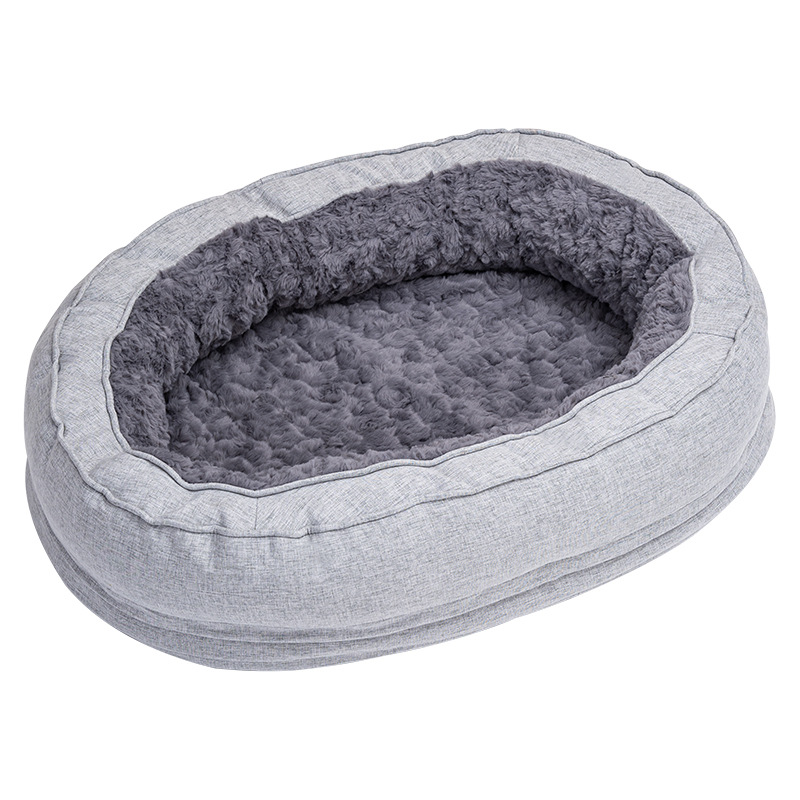
Give the digger something to dig. This was Biscuit’s whole issue. A bed with a raised rim — like the Cloud Donut Calming Bed — lets a dog paw, circle, and burrow into the bolster edge instead of ripping the middle apart. The raised rim cradles their head and paws, which also happens to calm anxious dogs; the nesting motion and the hug are the same comfort loop. Biscuit still circles three times before lying down. He just doesn’t excavate anymore.
Match firmness to the chewer. Soft plush is lovely for gentle sleepers, but a power chewer will treat it like a stuffed toy. A firmer memory-foam base — like the Bolster Sofa Dog Bed — is simply less fun to rip. There’s no satisfying fluff explosion, so most dogs lose interest. The L-shaped cushion still gives them a headrest to lean on, so they get the comfort without the shreddable filling.
Washable is non-negotiable. Here’s one nobody talks about: a bed that can’t be washed builds up smell, and built-up smell triggers more chewing. Dogs investigate strong odors with their mouths. A fully machine-washable bed (the donut) or a removable washable cover (the bolster) breaks that cycle. If a bed says “spot clean only,” walk away — that bed has a 6-month lifespan in a real house.
Size up, not down. Measure your dog sprawled out, nose to tail, then add 15–20 cm. A bed that’s technically “their size” but forces a tight curl will get bunched, dragged, and eventually torn. Dogs destroy beds they’re uncomfortable in far more than beds they love.
What I stopped buying
The $12 flat mats from the discount bin — dead in a week, and the thin foam inside crumbles into pieces small enough to swallow. That’s a vet bill, not a bargain. Calming sprays marketed for bed-chewing — the evidence is thin and the price isn’t. And anything labeled “chew-proof” with no explanation of how — if they can’t tell you the mechanism, there isn’t one.
What actually fixed it for us, in order of impact: a real evening walk (40 minutes, not 15), a frozen Kong when I leave, and a bed with a rim he can nest into. Bed destruction went from weekly to zero. The current bed is eight months old. It looks it — but it’s intact, and that’s the metric that matters.
So ask yourself: is your dog destroying the bed, or is the bed failing your dog? Nine times out of ten, it’s the bed.
Our picks for serial bed-destroyers
Cloud Donut Calming Bed — for the circlers, diggers, and anxious nesters. Raised bolster rim to burrow into, machine washable, warm neutral tones that don’t scream “dog furniture.”
Bolster Sofa Dog Bed — for the power chewers and big sprawlers. Memory-foam support, L-shaped cushion for leaning, removable washable cover. Less fun to rip, just as good to sleep on.
Cat vs. Christmas Tree: 5 Ways to Keep Your Tree Standing Through December
Every year, same ritual. The tree goes up the weekend after Thanksgiving — mine is a 7-foot fake spruce, heavy enough that I need two hands and a bad attitude to drag the box out of the closet — and within ten minutes, my cat Miso is sitting underneath it like a tiny furry landlord inspecting a new property.
By day three, she’s not next to the tree. She’s in it.
If you’re reading this with a cat asleep on your keyboard and a half-decorated tree in the corner, you know exactly what December looks like at your place. Ornaments on the floor. A tree leaning fifteen degrees to the left like it’s had a rough year.
Here’s the thing nobody tells new cat owners: you don’t win this fight by fighting the cat. You win by making the tree boring — and everything else more interesting. Five moves, tested over three Decembers with the same determined orange menace.
1. Give the claws a better address
Cats don’t scratch your tree because they’re evil. They scratch because scratching is how they stretch their backs, mark territory, and shed the dead outer layer of their claws. A Christmas tree trunk is basically a six-foot-tall scratching post that you decorated for them. From the cat’s perspective, you built it for them.
So don’t bother with deterrent sprays — in my experience they’re expensive air freshener with a picture of a cat on the bottle. Double-sided tape on the lower trunk works for about a week, until your cat decides it’s an interesting texture rather than a barrier.
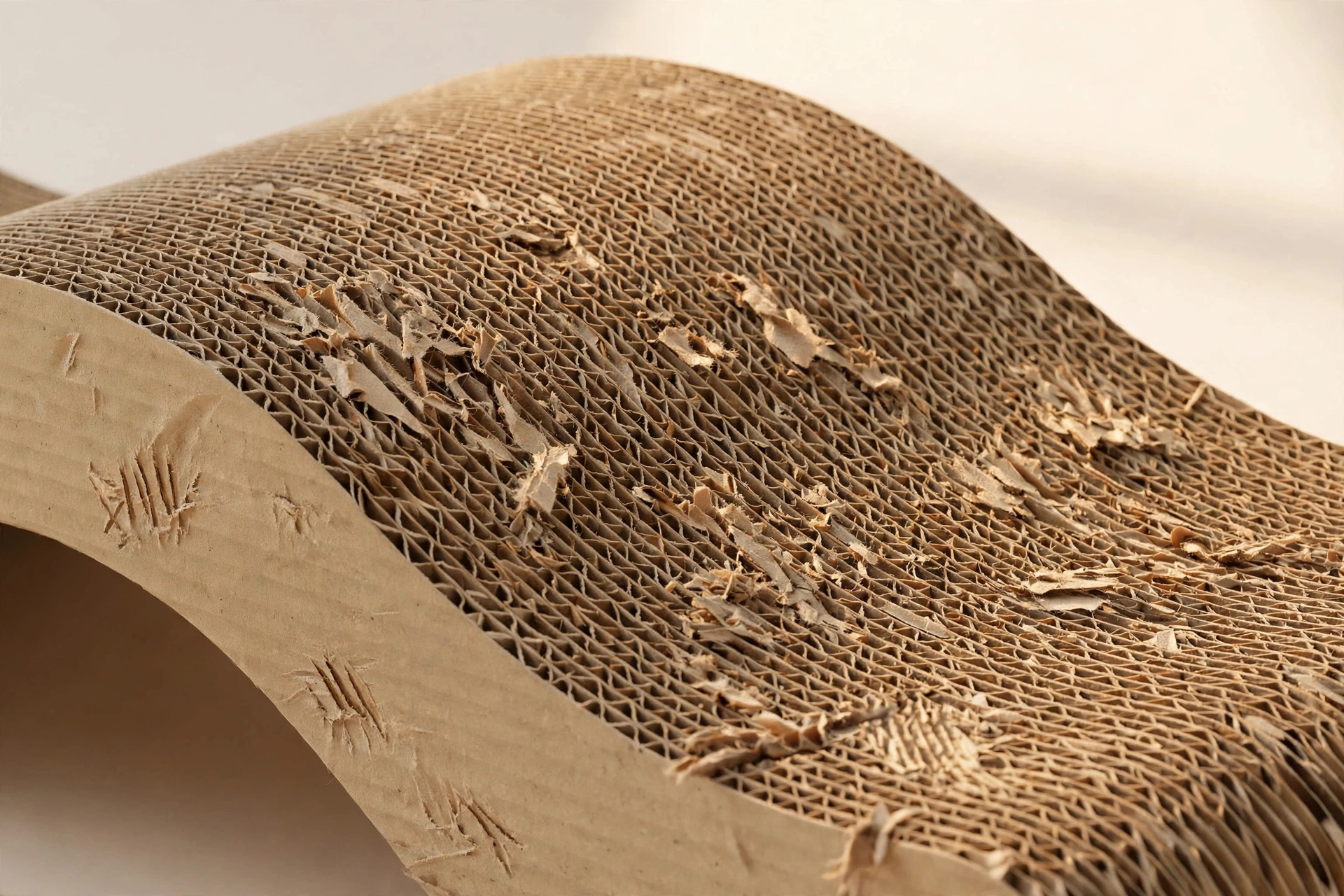
What actually works is a redirect with a better offer. I put the Scratch & Snooze right next to the tree — close enough that Miso has to walk past it to reach the trunk — and sprinkled the little pouch of catnip that comes in the box. The corrugated honeycomb surface is exactly the texture cats go for, and because it’s a lounger, she scratches for four minutes and then falls asleep in the curve without moving. First night: four solid minutes of scratching, then a two-hour nap. The tree hasn’t been touched since.
Two sizes, by the way — the standard 50 × 25 × 12 cm fits cats up to 5 kg, the large 65 × 30 × 14 cm handles up to 8 kg. And it’s reversible, so when one side gets shredded you flip it over for a fresh surface. Double the lifespan for zero extra dollars.
2. Drain the batteries before dusk
Most tree attacks happen between 9pm and midnight. That’s zoomies o’clock — the witching hour when an indoor cat suddenly remembers it’s a predator and your living room is the Serengeti.
You can’t train the zoomies out. But you can schedule them. The Zoomie Ball is a self-rolling ball that darts, pauses, and changes direction on its own — 7 cm across, 85 grams, three speed settings, and a motor under 40 decibels, which is quieter than my refrigerator’s hum. One full charge gives about two hours of play, recharges in about an hour, and it auto-sleeps after five idle minutes, then wakes the second a paw touches it. The obstacle sensor steers it away from walls and furniture by itself.
I run it on the medium setting around 7pm. By nine, Miso has done her hunting, and she’s parked on the couch instead of halfway up the spruce. A tired cat is a tree-friendly cat.
And skip the laser pointer while you’re at it. No catch, no payoff — just a frustrated cat chasing a dot she can never hold, and a red smear across your wall at 11pm. A ball she can actually pounce wins every time.
3. The 10-minute wand session, then dinner
Cats run on a cycle: hunt, catch, kill, eat, groom, sleep. In that order. If you play for ten minutes and then feed dinner, you hijack the whole sequence — the cat eats, grooms, and conks out right through the tree’s most dangerous hours.
The Flutter Wand is built for exactly this: real turkey and guinea fowl feathers, a flexible fiberglass rod that whips through the air like an actual bird, and a 90 cm cord that keeps your hands well clear of the claws. The feather heads quick-swap in seconds when one gets ragged. Ten minutes, then the food bowl hits the floor, then silence.
One safety note, and it’s printed on the product page for a reason: wand toys are supervised-play only. Feathers and string go in the closet when you’re done. A cat left alone with a wand cord is a vet visit waiting to happen.
4. Set up the tree like you own a cat (because you do)
A few setup choices that cost nothing and save everything:
- Heavy, wide base. A 7-foot tree in a wobbly stand isn’t decor, it’s a physics experiment. If you can rock the tree with one finger, so can 4 kg of determined cat.
- No tinsel. Ever. Tinsel causes linear foreign-body obstruction, and the surgery runs $1,500 to $3,000. It’s also, honestly, the cheapest-looking decoration on the tree. Ribbon garland gives you the same shimmer and can’t be swallowed in one 3am gulp.
- Shatterproof on the bottom three feet. Glass ornaments only live above cat-jump height — measure your cat. Miso clears 4.5 feet from the couch arm, so my glass starts at five.
- Real tree? Skip the water additives. Preservatives and fertilizers in the stand water are toxic, and cats drink from the weirdest bowls. Plain water, covered stand — or go fake. My hot take: a good fake tree plus one real pine-scented candle gets you 90% of the vibe with zero needle cleanup in January.
5. The first 48 hours decide everything
The tree is novel for about two days. That’s your window. Every time the cat investigates calmly — sniffs, sits under it, walks away — drop a treat. You’re paying for boredom. A cat that has thoroughly investigated the tree and found it unrewarding will ignore it by New Year’s.
And please, retire the spray bottle. It doesn’t teach “don’t climb the tree.” It teaches “climb the tree when the human isn’t looking.” A sneaky cat is worse than a bold cat — at least the bold one does it in front of you.
So: is your cat actually evil, or just bored at 11pm with a glittering tower of dangling toys in the middle of the living room? Redirect the scratching, drain the batteries, set the tree up like a cat lives there — and December gets a lot quieter.
The December survival kit
- Scratch & Snooze – Cardboard Lounge — the better scratching address, parked right next to the tree
- Zoomie Ball – Interactive Cat Toy — 7pm zoomies, on schedule
- Flutter Wand – Feather Teaser — ten minutes, then dinner, then sleep
Halloween Night With Pets: 6 Ways to Keep the Calm, Guard the Candy, and Survive the Doorbell
My street goes feral every October 31st. Fog machines on every porch, teenagers in realistic zombie masks, and a doorbell that rings roughly every six minutes from 5pm to 10pm. Two years ago my dog spent the whole evening pacing between the hallway and the couch, barking herself hoarse. My cat vanished behind the washing machine for four hours. Fun night for the kids, absolute chaos for the animals.
So I turned Halloween prep into pet prep. Here’s the six-step routine I now run every October 31st — learned the hard way so your pets don’t have to.
1. Build the bunker before the first knock
Don’t wait until the doorbell storm starts. Set up a safe room in the early afternoon: water bowl, litter box if you have a cat, and a proper anxiety bed. I use a cloud-soft donut bed with a raised bolster rim — the rim cradles the head and paws, so the dog physically curls into the padding. That tucked-in posture lowers the pacing and whining faster than anything I tried (treats, white noise, a t-shirt that smelled like me — none of it came close).
One practical note: whatever bed you use, it has to be washable. My dog drooled through three blankets her first Halloween. A machine-washable bed in warm neutral tones earns its keep in one evening.
2. Give the bunker a roof
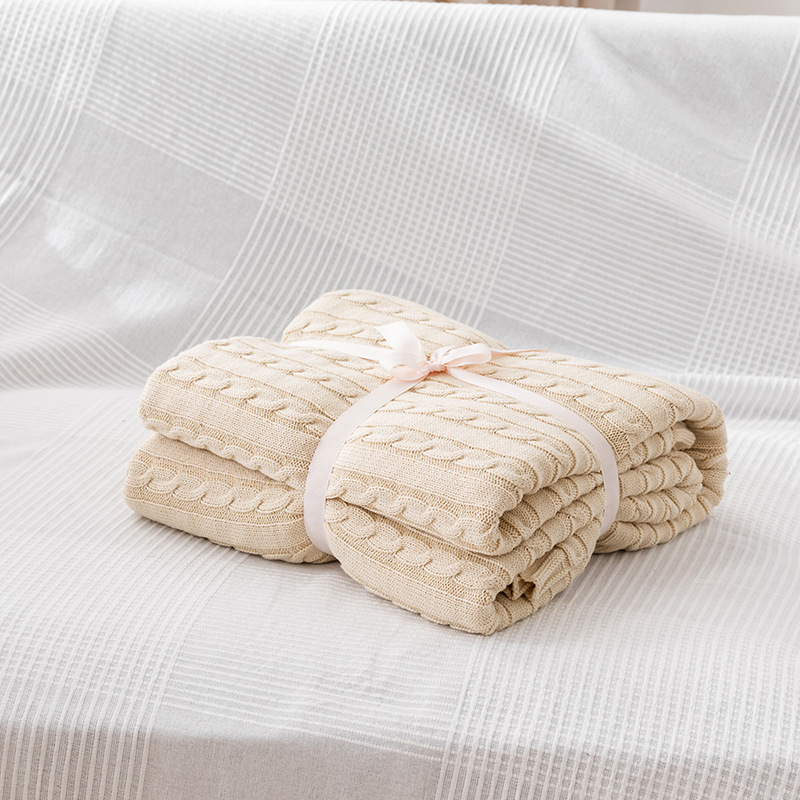
Dogs (and cats, honestly) calm down faster in enclosed spaces. I drape a chunky cable-knit cotton throw over the donut bed — instant little den. The knit is breathable, so it doesn’t trap heat, and the cotton weave is thick enough to muffle some of the hallway noise. The den trick works because darkness signals “nothing to guard,” and nothing to guard means nothing to bark at.
3. Walk them out before dark, walk them safe after
A tired dog barks at the doorbell less. Get the big walk done before the costumes come out — an hour, off-peak, let them sniff everything. If you must walk after dark, this is the one night of the year where visibility gear actually matters. Kids in dark costumes on bikes, cars slowing to gawk at decorations, low streetlight.
I switched to a Y-front harness for night walks. The Y-shaped front keeps all the pressure off the throat (critical for brachycephalic breeds and pullers), the neoprene-lined straps stop chafing, and the reflective trim catches headlights. Four adjustment points mean it fits a 30cm-chested Chihuahua and a 75cm-chested Golden — measure around the widest part of the chest, behind the front legs, and leave two fingers of slack. Front D-ring for training, back D-ring for the actual walk.

4. Candy is a landmine
Here’s the number to tattoo on your brain: 20 grams of dark chocolate can poison a 10kg dog. The candy bowl sits at adult height — never the coffee table — and any kid drops a Snickers on the floor, it’s confiscated before the dog reaches it. Teach “leave it” year-round if you can, but on Halloween just manage the environment: dog stays in the bunker room during trick-or-treat hours, and nobody walks the candy zone with a leash in one hand and a phone in the other.
5. Cats: doors stay shut, all of them
Cats don’t get anxious the way dogs do — they get gone. A startled cat can slip through a door cracked six inches, and Halloween is peak lost-pet night at every shelter I know. My rule: the cat goes in the safe room at 4pm with food, water, and a litter box, and the front door opens through the garage or side door all evening. No exceptions, no “just this once.”
6. Skip the pet costume
I’ll say what the costume companies won’t: the vast majority of pets hate costumes. My dog tolerated one for exactly four minutes before the freezing started — that glazed, motionless look that means “I have shut down.” A bandana is the max. Five minutes of photos, then off. The cutest-dog-contest photo is not worth an hour of your animal hiding under the bed.
So that’s the routine: bunker by 4pm, den with a roof, big walk before dark, reflective gear after, candy locked down, cat secured, costume skipped. Takes twenty minutes of prep and buys you a peaceful evening. The kids get their candy; your animals get their quiet. Everyone wins.
The Halloween kit
Cloud Donut Calming Bed — raised bolster rim that cradles heads and paws, easing anxiety for calmer sleep; machine washable, warm neutral tones.
Cable Knit Throw Blanket — chunky, breathable cotton knit; drape it over the bed or crate to build the den.
Comfy-Y Harness — Y-front keeps pressure off the throat, neoprene padding, 4 adjustment points, reflective trim for night walks; S (30–45cm), M (40–60cm), L (55–75cm).
Road Tripping With Your Dog? Set Up the Backseat Right and They’ll Sleep the Whole Way
The first time I drove four hours to the coast with my beagle mix, I made every mistake in the book. She paced the backseat for the first 90 minutes, panted into my ear through the headrest gap, then wedged herself between the front seats and refused to move. By hour three I was steering with one hand and holding a leash with the other. Never again.
Here is what I got wrong: I treated the car like a problem to survive instead of a place to set up. Dogs don’t hate cars. They hate unfamiliar. A car is a loud box that smells like nothing they know, and then we ask them to nap in it. Fix the unfamiliar part and most dogs settle down in about 20 minutes. This is the setup that finally worked for us.
1. Bring their bed, not a pile of old towels
Their bed smells like home — weeks of naps baked right in. A familiar smell is the cheapest calming aid there is, and you already own it.
I lay our Bolster Sofa Dog Bed across the backseat. The L-shaped bolster does something clever on the road: when I take a curve, she leans into it instead of sliding sideways. The memory foam eats the small vibrations that make dogs restless. She curled up in it exactly the way she does on the couch at home — same bed, same position, four hours from the living room. She slept for two of those four hours. Coincidence? She had never slept in the car before.
Honest opinion: skip the “pet car seats” with five straps and a 20-minute installation video. A bed your dog already loves beats any gadget they have to learn. If it smells like home, half your battle is over before you turn the key.
2. One throw blanket on top — for them and your seats
The Cable Knit Throw Blanket goes over the bed and the seat. It does two jobs at once. Dog hair lands on the blanket instead of your upholstery — one good shake at the rest stop and you’re clean. And the chunky cotton knit is breathable, so there’s no sweaty vinyl smell on a warm afternoon drive.
Those waterproof “dog car seat covers” that crinkle like a chip bag? I’ve tried two. My dog refused to sit on either one. Not worth buying. A washable throw in a neutral shade wins, and here’s the hidden bonus: road-trip dog photos are about 30% of the fun. Don’t pretend you’re not going to take any.
3. The rest-stop routine: every 2 hours, 15 minutes
This is the step most people skip, and it’s the one that matters most. Every two hours: park, leash up, let them sniff. Sniffing is a dog’s decompression valve — 15 minutes of free sniffing tires a dog out more than a 30-minute forced march. A tired nose means a quiet backseat.
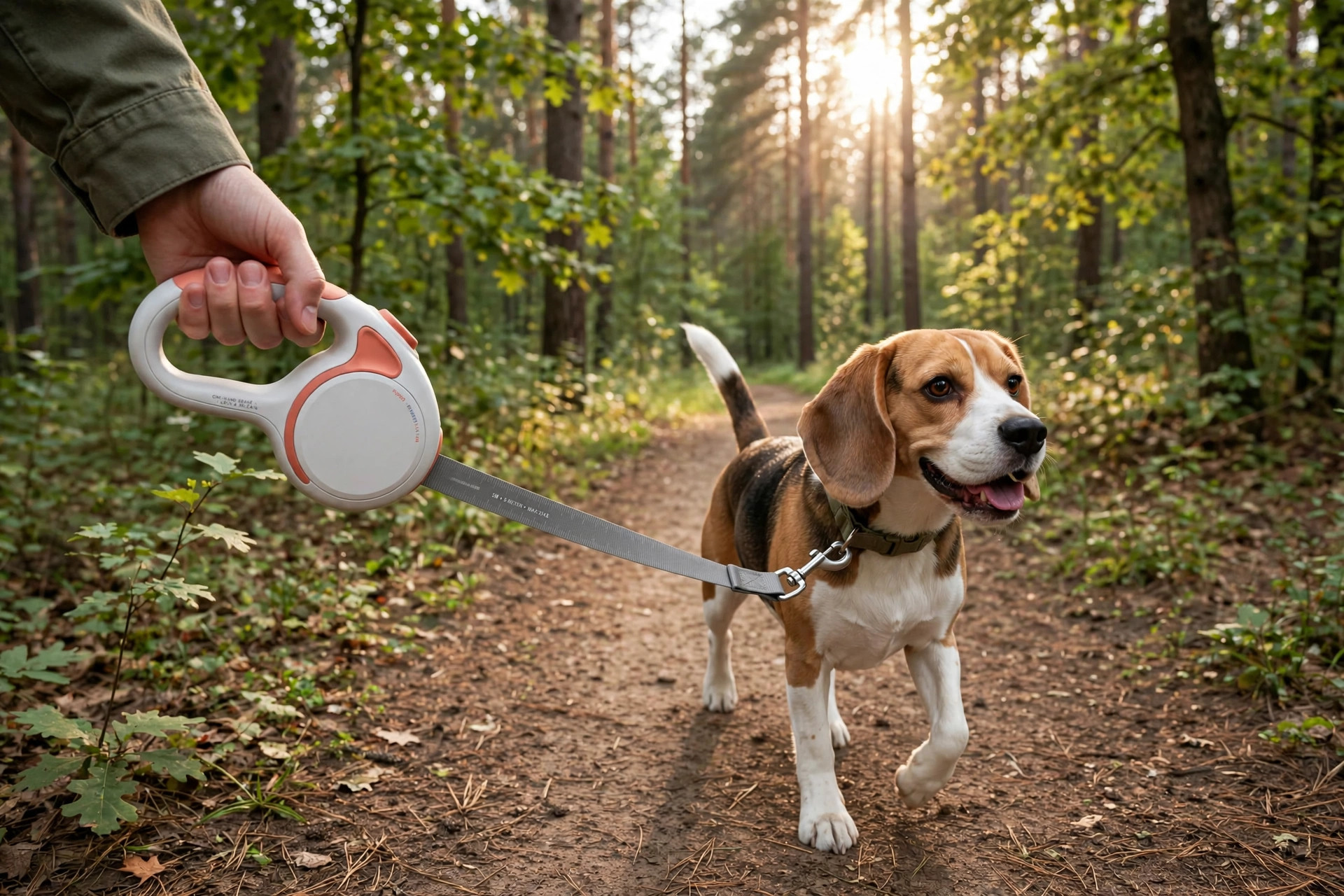
At a quiet, grassy rest stop I let the Roam Retractable Leash all the way out and let her pick her own sniffing route. The one-touch brake is the whole reason this works on the road: another dog appears 20 meters away, thumb down, and she’s back at my heel. But — and this is non-negotiable — lock it short the second you’re near the parking lane, the trash cans, or a crowd. The product’s own safety note says to lock short near roads, other dogs, and people. That’s not legal fine print. That is the entire skill of using this leash.
One more thing: don’t buy the 3 m version for road trips. Get the 5 m. A dog needs about four or five meters just to find a bathroom spot without you hovering over them like a helicopter.
You wouldn’t sit in a car for four hours without a bathroom break — why would you expect them to?
The boring details that actually matter
Feed their last meal a full hour before departure, not in the parking lot. Offer water at every stop, not just the big ones. And if your dog gets carsick, don’t make a four-hour drive their first trip — start with 20-minute practice runs for a week. Boring advice. Works every time.
A calm dog in the backseat isn’t luck. It’s a bed that smells like home, a blanket that keeps everyone comfortable, and a leash routine that lets them be a dog every couple of hours. Pack those three things and the drive gets quiet fast.
What we used on this trip
- Bolster Sofa Dog Bed — memory foam, L-shaped cushion, removable washable cover. Their bed from home, now in the car.
- Cable Knit Throw Blanket — breathable cotton knit that protects the backseat and adds a familiar layer.
- Roam Retractable Leash — up to 8 m of sniffing freedom at rest stops, one-touch brake when it counts.
Cat Stealing Your Warm Spot? Why Cold Mornings Push Cats Onto Laptops — and Into a Cup Bed
The first cold morning of the season, my cat made her decision before I had even finished my coffee. I sat down at my desk, and there she was — curled up on my laptop keyboard, tail tucked over her nose, fast asleep on top of the warmest rectangle in the flat. I lifted her off. She walked back. I lifted her off again, and she gave me the look cats reserve for people who clearly do not understand how the world works. By 9 a.m. she had also tried my pillow, the folded blanket on the sofa arm, and the one square of sunlight on the rug that had not yet moved. Does your cat do this too, the moment the temperature drops?
It is not spite, and it is not really about the laptop. Cats run warmer than we do, and when the air cools they go looking for heat the way we go looking for a sweater. A curled-up cat is a cat doing physics: tuck the paws in, wrap the tail around the nose, shrink the surface area, keep the warmth where it belongs. The problem is that every warm spot in your home already belongs to you — your chair, your side of the bed, the keyboard you are actively typing on. So the cat picks the warmest available compromise, which is usually right on top of your work.
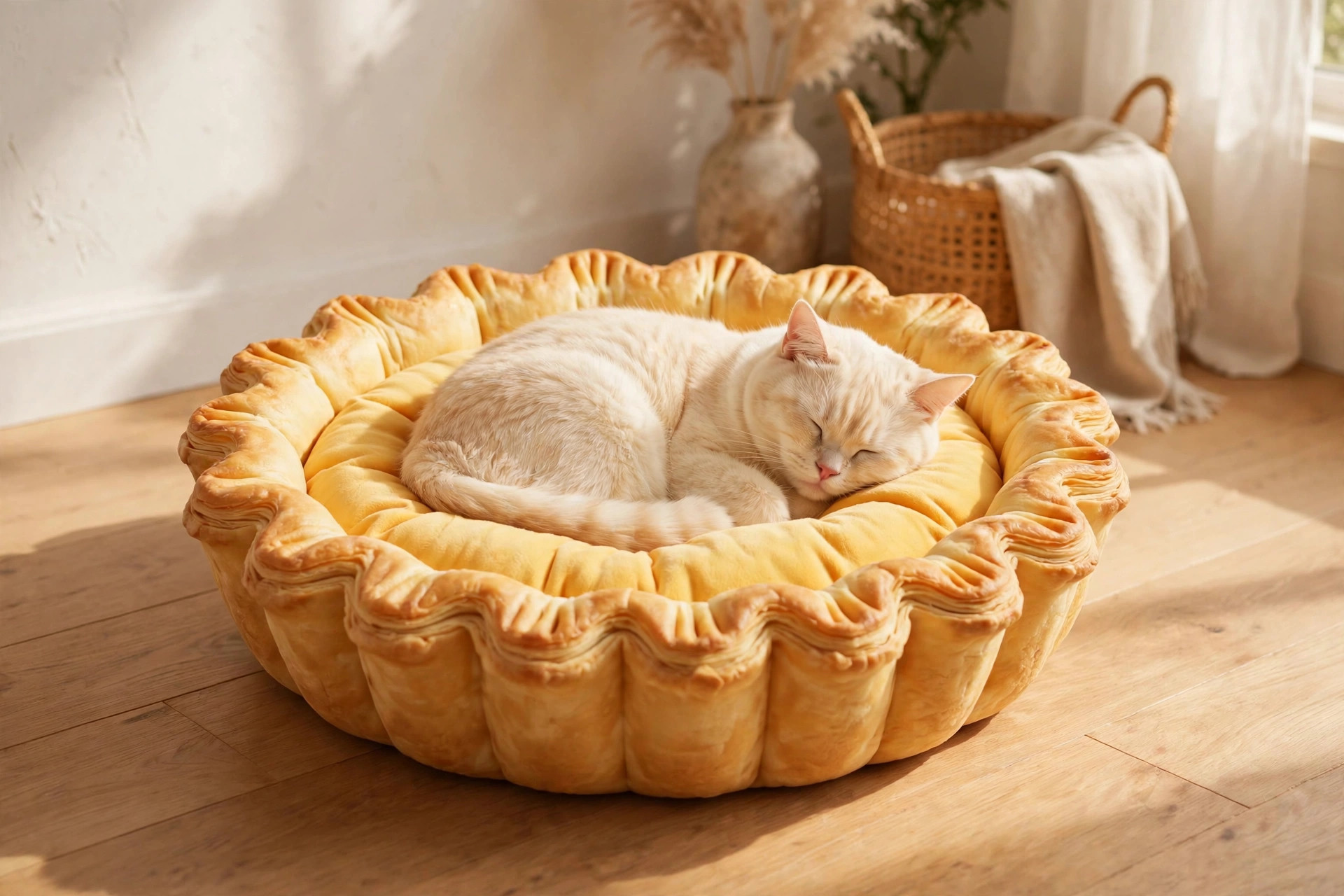
That is why I stopped trying to win the argument and gave her a warmer spot of her own. The Custard Cup Bed looks like a Portuguese egg tart. The high rounded walls are the whole trick. They block drafts from three sides, they give a cat something to press its back against, and the plush exterior traps body heat instead of letting it leak out into the room. A flat mat cannot do that. A thin blanket folded on the floor cannot do that either — the cat lies on it for ten minutes, the heat spreads out underneath, and off it goes to your pillow again.
Size matters more than people think, and this is where I almost got it wrong. I nearly bought the bigger size “so she has room to stretch,” which sounds generous and is exactly backwards for a cold-weather bed. A cat that wants warmth wants to curl, not sprawl. The small Custard Cup is 45 cm across and 20 cm high, for cats up to 4 kg. The medium is 55 cm across and 22 cm high, for cats up to 7 kg. My cat is just over 4 kg, so she got the medium, and she fills it edge to edge when she curls — which is the point. A bed with two inches of empty space all around it is a bed that stays cold. Measure your cat curled up, not stretched out, and buy the size she actually fills.
Placement did as much work as the bed itself. I put it where she already liked to be: next to my desk, in the morning sun patch, out of the hallway draft. Not next to the radiator — a bed parked against a heater dries the air out and the cat will abandon it by noon — and not in a spare room nobody uses, because a bed in a room the cat never visits is just decoration. The non-slip base turned out to matter too. She leaps into it from the desk chair some mornings, and a bed that slides across a wood floor is a bed a cat stops trusting after exactly one skid.

Here is an opinion I will not soften: do not buy an electric heated pad and leave it running all day as the fix. I tried one two winters ago. The cat loved it for a week, then started avoiding it, and I spent the whole time worrying about leaving it plugged in while I was out. A plush bed that holds the cat’s own body heat does the same job without a plug, without a timer, and without the low-level worry. If your cat is elderly or arthritic and your vet has specifically suggested extra warmth, that is a different conversation — but for a healthy cat that just wants a warm curl-up spot, passive warmth wins.
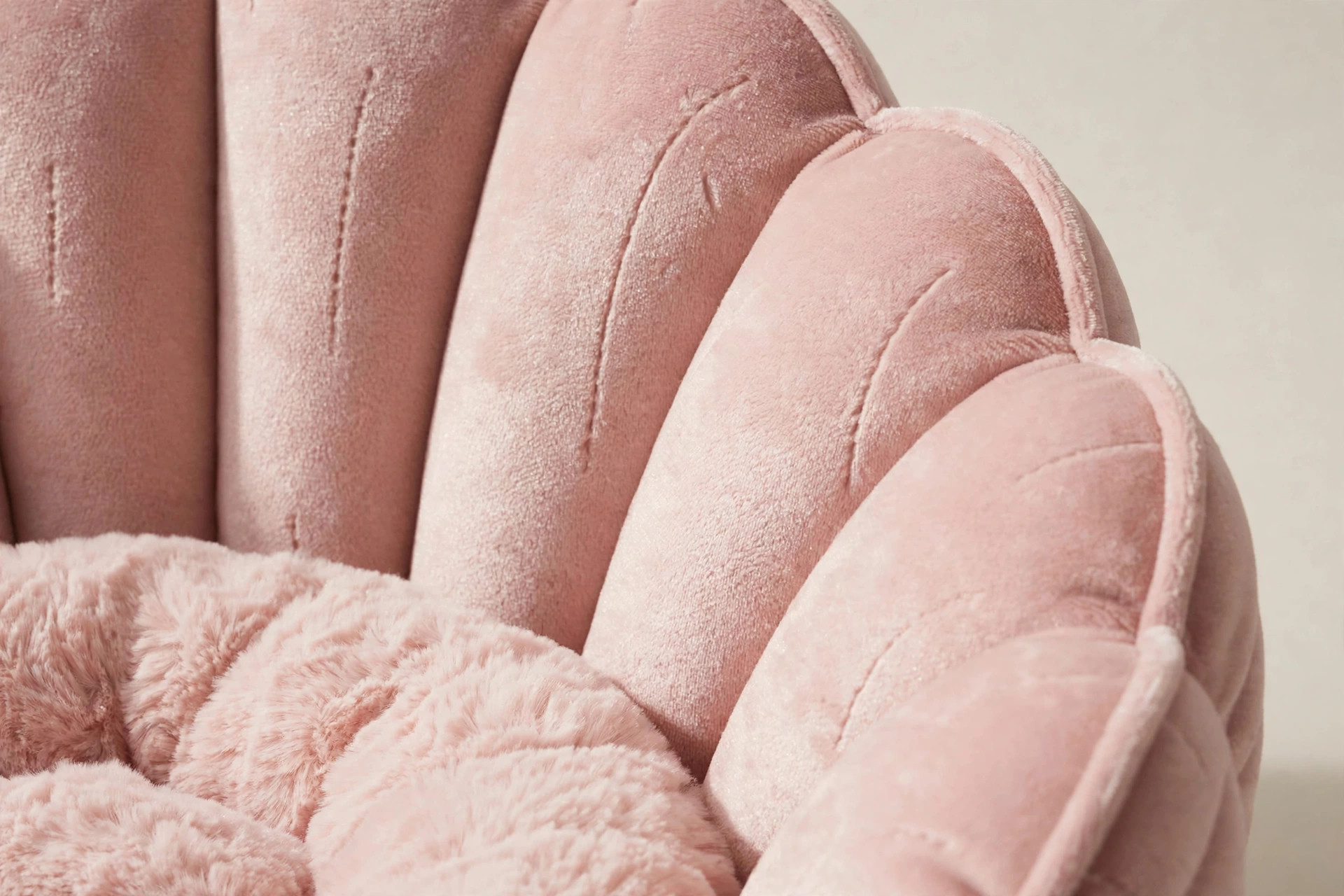
What about the cat that runs hot? Not every cat wants a heat trap. My friend’s tabby sprawls flat on his back in October, legs everywhere, and would treat a deep cup bed like a sauna he did not ask for. For that cat, the Seashell Snuggle Bed is the better call: raised scalloped edges to rest a head on, but a breathable velvet design that does not cook a cat that already runs warm. Same idea — a defined spot with edges — different thermostat. Watch how your cat sleeps for three nights before you buy. Curler, or sprawler? That one observation will save you a return.
Getting a cat to actually use a new bed takes about a week of not forcing it. I put a worn t-shirt of mine in the cup bed for two nights so it smelled like home, dropped a treat in it every morning without any ceremony, and never once picked her up and placed her in it. Cats treat a bed they were put into as a trap. A bed they discovered, with a treat already in it, is their idea. By day five she was napping in it by choice. By day eight my keyboard was mine again — well, mine except for the one morning she sat on it just to remind me who runs the flat.
Washing is the part nobody asks about until the bed smells like a cat that has slept in it for a month. The Custard Cup goes in the machine on a cold gentle cycle, then tumble dry low or air dry, and a quick fluff brings the PP cotton filling back. I wash it every three or four weeks in winter — more often and the filling loses its bounce, less often and you can smell it from the doorway. One bed, washed on a schedule, beats rotating through a smell problem.
So if your cat is currently asleep on your keyboard, or has claimed the warm dent in your pillow before you have even left the bed, try the boring solution before the clever one. Put a cup bed where the sun lands in the morning, near where you actually sit, in the size your cat fills when curled. Give it a week, a worn t-shirt, and a treat a day. The laptop is a terrible cat bed with a very good heating system. Your cat just has not been offered anything better yet.
Shop the beds in this article: Custard Cup Bed — high rounded walls and plush that traps body heat, for cats who love to curl up, machine washable on a gentle cycle. Seashell Snuggle Bed — scalloped velvet bed with raised edges and a breathable design, for cats who run warm and like to stretch out.
My Dog Follows Me to the Bathroom. Teaching a Velcro Dog to Love Its Own Spot
I work from home, and for a while my dog treated that as a full-time job of his own: following me. Kitchen, bathroom, balcony door — if I stood up, he stood up. If I sat down, he wedged himself onto my feet like a 25-kilo pair of slippers. It was flattering for about a week. Then I realised I could not even make coffee without tripping over him, and worse, the moment I left the flat he would pace the hallway and whine at the door. He was not being naughty. He just had no idea where he was supposed to be when I was not right next to him.
That is the part most velcro-dog advice skips. People tell you to tire the dog out, or to buy a calming chew and hope for the best. A tired dog still follows you; it just follows you more slowly. And a chew lasts 10 minutes. What my dog actually needed was a place — one spot in the flat that belonged to him, that felt better than my feet, and that he could go to without being told twice. Not a punishment corner. A good spot. Do you have one of those in your home right now, or does your dog just sleep wherever you happen to be standing?
We started with the bed, because location matters more than willpower. The Cloud Donut Calming Bed went into the corner of the living room where he could still see me at my desk but was not in the walkway. The raised bolster rim is the whole point here: he can bury his head into it and curl up with his paws tucked in, and the rim hugs him back a little. Dogs that feel exposed do not settle. Dogs that feel tucked in do. I put the bed there and then — this is important — I did not make a big ceremony out of it. No pointing, no excited voice, no ten-minute speech about his new bed. I just put a few treats on it and walked away.
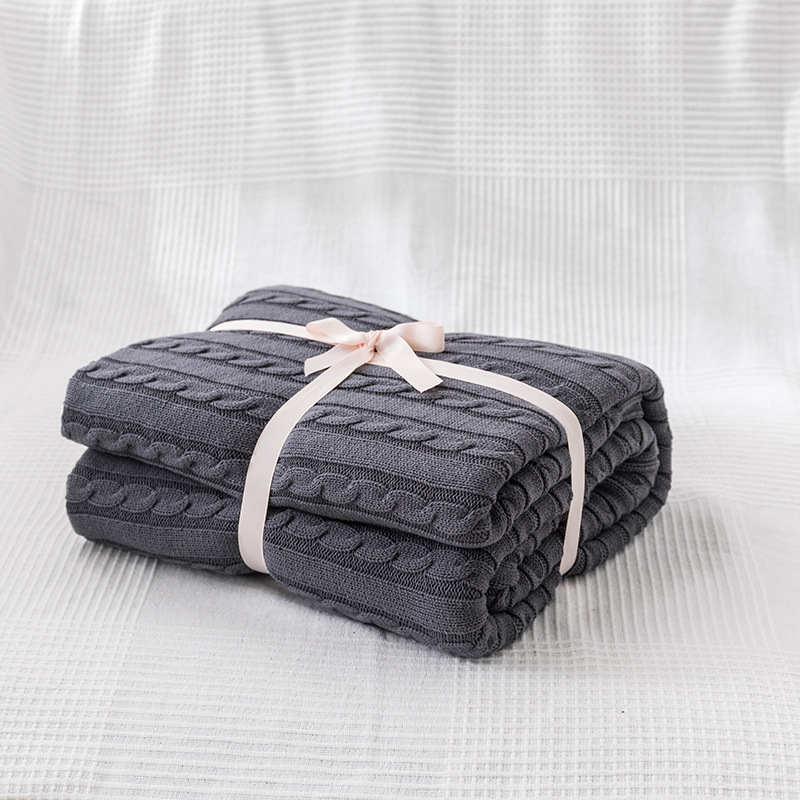
On top of the bed I draped the Cable Knit Throw Blanket, folded in half. It is chunky cotton, breathable rather than sweaty, which matters because a dog that overheats will abandon the bed and come straight back to your feet. The blanket also does a quieter job: it smells like the house. After a week of naps on it, it smells like him, and that familiarity is half the training. I did not buy a special pheromone spray for this, by the way. I think most of them are an expensive way of avoiding the actual work, which is teaching the dog that staying put pays off.
Here is how the actual training went, in the unglamorous version. Three short sessions a day, never more than 5 minutes each. I would walk him to the bed, say “place” once, and drop a treat between his paws when he stepped on. Then I took one step back. If he stayed, another treat. If he got up, I said nothing, walked him back calmly, and started again. Day one, he lasted about 30 seconds before following me. Day four, he made it to 2 minutes while I stood in the kitchen doorway. By the end of the second week he was walking to the bed on his own when I sat down at my desk, because the bed had become the place where good things happened, not the place where he got sent away.
The step everyone rushes is leaving the room. Do not go from “dog stays while you stand nearby” to “dog stays while you leave the flat for an hour.” That is how you get a dog that panics and shreds the blanket. I built it up in silly little increments: step into the hallway for 10 seconds, come back, treat. Step out for 30 seconds, come back, treat. Close the front door, count to 20, come back in before he started whining. The rule I set myself was simple — I only ever returned while he was quiet. If he was already whining, I waited for a 3-second gap before opening the door, so I was never rewarding the noise itself.
What about the days it fell apart? Plenty of those. A delivery driver knocked, he bolted off the bed, and we started the session over from zero. A thunderstorm sent him straight back to my feet for an evening, and I let him. Training a place is not about winning every single day; it is about the average over two or three weeks trending in the right direction. If your dog is drooling, panting hard, destroying door frames, or hurting itself when left alone, that is past the point of a bed and a blanket — talk to your vet or a qualified behaviourist, because real separation anxiety sometimes needs more than a training plan.
One opinion I will stand behind: do not buy a bigger crate to solve this. A dog that follows you because it is anxious does not need a smaller world; it needs a better spot in the world it already has. A bed it can choose, in a corner it can see out of, with a blanket that already smells like home — that is a place a dog will actually go back to on its own. Mine now does. He still follows me to the kitchen sometimes, out of habit, but when I sit down to work he walks to his corner, circles twice, and drops into the donut with a sigh you can hear across the room. That sigh is the whole payoff.
So if your dog is currently asleep on your feet while you read this, try this tonight: put the bed where you actually spend your evenings, fold the blanket over one corner, and run one 5-minute session before dinner. Not ten sessions. One. Then do it again tomorrow. In two weeks you might have something I did not think I would ever get — a dog that is happy in its own spot, and a hallway you can walk down without a shadow.
Shop the spot in this article: Cloud Donut Calming Bed — raised bolster rim that cradles heads and paws, easing anxiety for calmer sleep, machine washable. Cable Knit Throw Blanket — breathable cotton, draped over a sofa or your pet’s favourite corner for an extra layer of cozy.
Dog Bed Smells? How to Wash It Without Flattening It
I noticed the smell on a rainy Tuesday. My dog had been napping in his donut bed all week, the house windows were shut, and when I lifted the bed to vacuum under it, the underside smelled like wet socks and old popcorn. Not terrible. Just unmistakably dog. I had put off washing it for a month because I was convinced one spin cycle would turn the fluffy rim into a sad, flat pancake. It did not. It just needed a gentler wash than the one I had been imagining.
Here is the thing most of us get wrong: we treat a dog bed like a blanket. It is not. A blanket is one flat layer. A donut bed has a stuffed rim, a filled base, and seams that take a beating every time a 25-kilo dog circles three times and drops into it. Wash it like a blanket — hot water, a long heavy cycle, high heat in the dryer — and you will flatten exactly the parts your dog loves most.
Start with the label, and then ignore half of what the internet tells you. The Cloud Donut Calming Bed is machine washable, which is the whole reason I bought it. Machine washable does not mean indestructible. I vacuum the bed first, crumbs and loose fur and all, and shake it out over the balcony. If there is a spot — muddy paws, a drool patch — I dab it with a little plain dish soap and cold water and leave it for 10 minutes. No bleach. I learned that one the hard way on a white throw years ago, and yellowed fabric is not a look.
Then comes the wash itself, and this is where I get specific because vague advice is what ruined my first dog bed. Cold water, or 30 degrees at most. Gentle cycle. A small amount of unscented detergent, about half what you would use for a normal load. Skip the fabric softener and skip the scented beads. Your dog will sleep with its nose pressed into that rim for 12 hours a night — do you really want it breathing in a fake lavender field? The beads also coat fibres, and coated fibres stop absorbing the very moisture you are trying to wash out.
What about a bed with a removable cover? That is a different job, and honestly an easier one. The Bolster Sofa Dog Bed has a removable, washable cover, so the memory-foam core never has to go near the machine at all. Unzip the cover, wash it the same way — cold, gentle, unscented — and wipe the foam core with a damp cloth. If the foam itself smells, sprinkle it with baking soda, leave it for 2 hours, vacuum it off. I do this once a month and the core still holds its shape after a year of daily use.
Drying matters more than washing, and almost nobody says this. A donut bed that comes out of a hot dryer will feel fine for a day and then go flat within a week, because the heat breaks down the loft of the filling. I air-dry mine over a drying rack, flipping it once after about 4 hours, and it takes most of a day. If you are in a hurry, tumble dry on the lowest heat setting for 20 minutes, then finish it in the air. When it is dry, punch the rim back into shape with your fists — really work it — and let it sit for an hour before your dog claims it again. The rim bounces back further than you expect.
How often should you bother? My honest answer: wash the bed every 3 to 4 weeks if your dog sleeps in it nightly, more often in summer or after a muddy season. A bed that smells even after a proper wash, or a bolster that stays flat no matter how much you punch it back into shape, is telling you something. Foam crumbles, filling clumps, and no amount of detergent fixes a bed that has structurally given up. That is when you replace it, not when you buy a stronger-smelling detergent to cover the problem.
One more opinion, since you asked for a real one: do not buy a bed you cannot wash. I know, the fancy ones with the dry-clean-only tag look beautiful in the shop. But a dog bed is not a display piece. It gets rained on, drooled on, and slept on by an animal that just rolled in something mysterious at the park. A bed that cannot go in the machine is a bed you will live with smelling for months. Washable is not a nice extra. It is the whole point.
So, if your dog’s bed smells right now, do not put it off another week. Vacuum it tonight, wash it cold tomorrow morning, and let it air-dry while you are out. Your dog gets a fresh bed. You get a living room that stops smelling like a kennel. Everybody wins — especially the dog, who will immediately roll on the clean bed and undo about 10 percent of your work, and that is fine too.
Shop the beds in this article: Cloud Donut Calming Bed — machine washable, with a raised bolster rim for head-resting sleepers. Bolster Sofa Dog Bed — memory-foam support with a removable, washable cover.
Why Does My Cat Knead? The Real Reasons Behind the Biscuit-Making (and When to Step In)
It was 2:14 in the morning when the tiny needles started. My cat had climbed onto my chest, switched on her motor — that loud, rattly purr — and begun pressing her paws into me, one after the other, claws out just enough to remind me they exist. Through a T-shirt, it feels like someone poking you with the blunt end of ten pins. And yet I lay there smiling, because I knew what she was doing. She was making biscuits.
If you live with a cat, you know this ritual. The rhythmic pressing, the half-closed eyes, sometimes a bit of drool. It looks ridiculous. It can hurt. And it is one of the most honest things a cat ever does. So what is it, really — and when should you do something about it?
It starts with milk
Kittens knead their mother to stimulate milk flow. Press, release, press, release — the motion pushes milk down, and the kitten gets fed. Most cats never fully drop the habit. The wiring stays: soft surface plus contentment equals paws moving on their own. That is why your adult cat kneads your lap, your blanket, your pillow, and occasionally your face at 2 a.m. She is not confused. She is replaying the safest feeling she has ever known.
That also explains the drooling. Some cats drool a little while they knead, the same way a kitten would while nursing. It looks alarming the first time. It is usually just the old program running in full.
Four reasons your cat is kneading right now
She is happy. This is the big one. A cat that kneads on you, slowly, eyes half shut, purring, is telling you something she will never say in words: this spot is safe, you are safe. Take the compliment, even if the claws are out.
She is marking you. Cats have scent glands in their paw pads. Every press leaves a little of her scent behind. When she kneads your sweater, she is, in her own way, labeling it. You are hers now. The sweater was never really yours.
She is making a nest. Wild cats pat down grass and leaves before lying down. Your cat does the same to your duvet, your sofa cushion, and the pile of laundry you just folded. Twenty seconds of kneading, a slow circle, then down. If your cat kneads and then sleeps, that is the whole sequence working as designed.
She is calming herself down. Kneading is self-soothing. A cat that has just come home from the vet, or heard the vacuum cleaner, or watched a stranger walk through the house, may knead harder and faster than usual. It is her version of a deep breath. A sudden, big increase in kneading — especially paired with hiding, eating less, or avoiding the litter box — is worth a vet visit, because pain and stress can hide behind the same behavior. But everyday kneading is not a problem to fix.
When it hurts: what actually works
Here is the part nobody tells you: pushing the cat off does not work. She comes back, or she learns that your lap is not safe after all, and you lose the one ritual that meant she trusted you. Three things work better.
Trim the claws. Not declawing — never declawing, that is surgery on a cat’s toes and it changes how she walks. Just a regular trim every two to three weeks, taking only the sharp hook at the tip. A kneading cat with trimmed claws is a completely different experience. Most cats tolerate it fine if you do one paw at a time and stop before they get annoyed.
Put a thick blanket on your lap before she settles. This is the lowest-effort fix in cat ownership. A folded throw between you and the paws turns needles into pressure. You keep the purring. She keeps the ritual. Everyone wins.
Give her a surface worth kneading. Cats pick soft, slightly springy textures — the kind that give a little under their paws. That is why so many kneaders end up on velvet and plush instead of the flat, hard bed you bought with such confidence. A bed with a plush, kneadable surface and raised edges she can lean into gives her the whole sequence in one place: knead, circle, sleep.
The thing I would not buy
While we are being honest: kneading mittens — those padded gloves sold to protect your lap — are a waste of money. They are hot, your cat steps on a weird crinkly thing instead of you, and the whole point of the ritual is contact. A blanket does the same job for free. And anything marketed as a “kneading deterrent” spray is solving a problem that is not a problem.
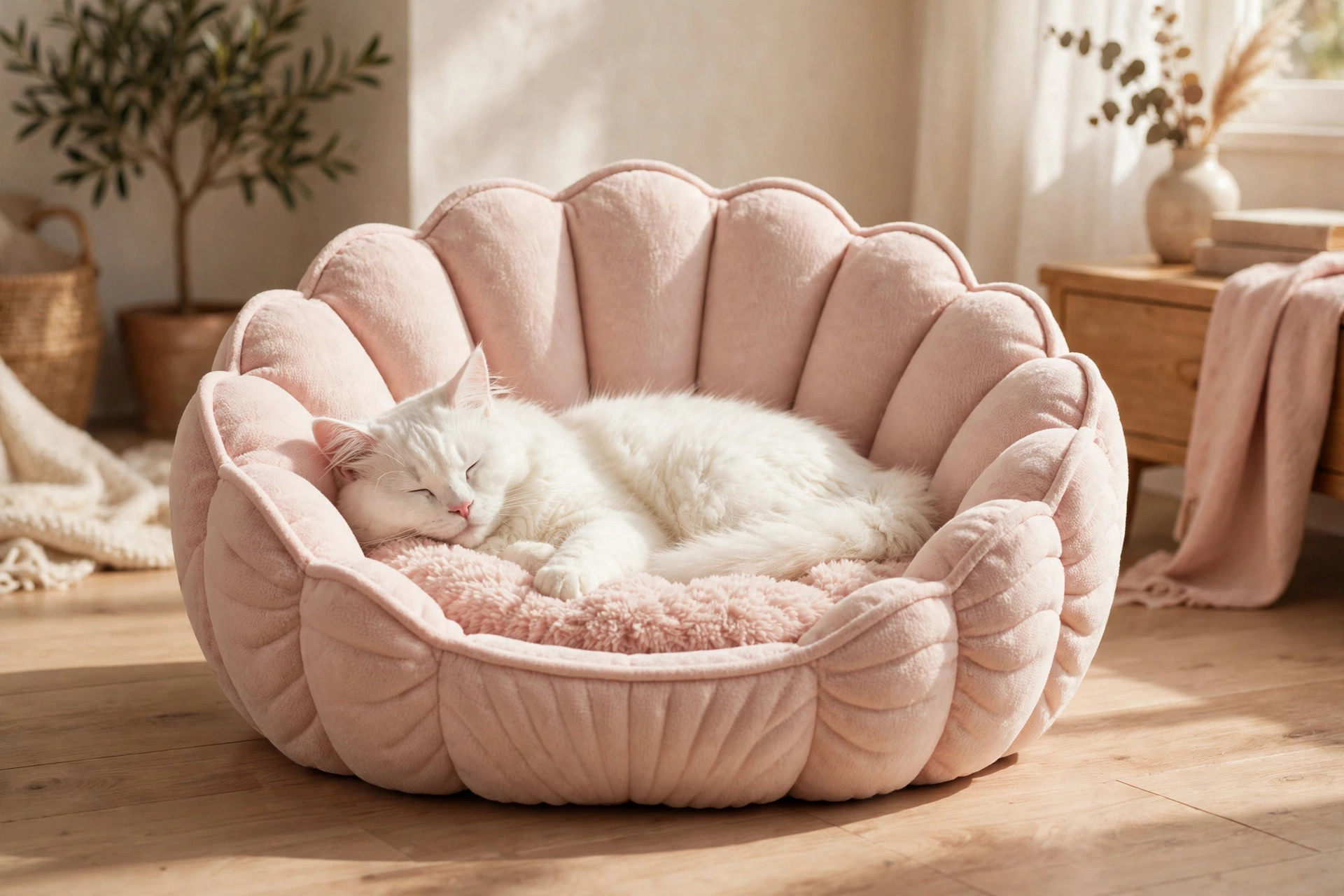
What does work is matching the bed to the behavior. The Seashell Snuggle Bed is the one my kneader picked over every other bed in the house, and I can see why: the velvet plush is the texture paws hunt for, the scalloped edges make a perfect headrest for the post-knead nap, and the raised edges give that tucked-in feeling without trapping her. The weighted base means it stays put when she leaps in mid-zoom. It comes in M (50 × 40 × 22 cm, cats up to 5 kg) and L (60 × 48 × 25 cm, cats up to 8 kg), and it is machine washable on a cold gentle cycle — which matters, because a bed a cat kneads daily is a bed that collects fur and the occasional claw snag. Brush the velvet after washing and it comes back soft.
If your cat is more of a curler than a kneader — the kind that folds into a tight ball with her nose tucked under her tail — the Custard Cup Bed is the other one worth a look. Tall rounded walls, a deep plush cup, and it actually traps body heat, so it suits cats that run cold and senior cats that want warmth.
So let her knead
Next time the paws start up at an unreasonable hour, try this: leave her be, slide a blanket under the claws, and listen to the purr. A cat does not knead on people she does not trust. The needles are annoying. The message underneath them is not. How many of us get told, that plainly, that we are home?
Related picks: Seashell Snuggle Bed · Custard Cup Bed