Kitten Biting Your Hands and Feet? Redirect the Hunt Drive With a Feather Wand
It’s 7 in the morning. You’re half awake, feet under the blanket, and suddenly — tiny fangs sink into your ankle. Then your other ankle. Then your hand when you reach down to push the little monster away.
If you live with a kitten, you know this ambush routine by heart. And I have bad news and good news. The bad news: yelling “no!”, clapping your hands, or spritzing water at them won’t fix it. I tried all three with my first kitten. All I got was a kitten who learned to bite me when I wasn’t looking.
The good news? Your kitten isn’t being mean. It’s not dominant, it’s not angry, and it definitely doesn’t hate you. It’s hunting you. And once you understand that, the fix is almost embarrassingly simple.
Your ankles look exactly like prey
Here’s the thing nobody tells new kitten owners: a kitten’s brain runs one program on loop — stalk, chase, pounce, bite, kick. In the wild, a kitten practices this sequence hundreds of times a day on leaves, bugs, and its littermates. In your apartment, the only things that move at ankle height and twitch under fabric are your feet.
So the biting isn’t a behavior problem. It’s a hunting problem with no outlet. Punishing a kitten for hunting is like punishing a retriever for fetching — you’re fighting the animal’s entire operating system, and you’ll lose.
What actually works is giving that hunt drive somewhere better to go. Every single day. For about ten minutes.
The 10-minute hunt that fixes the biting
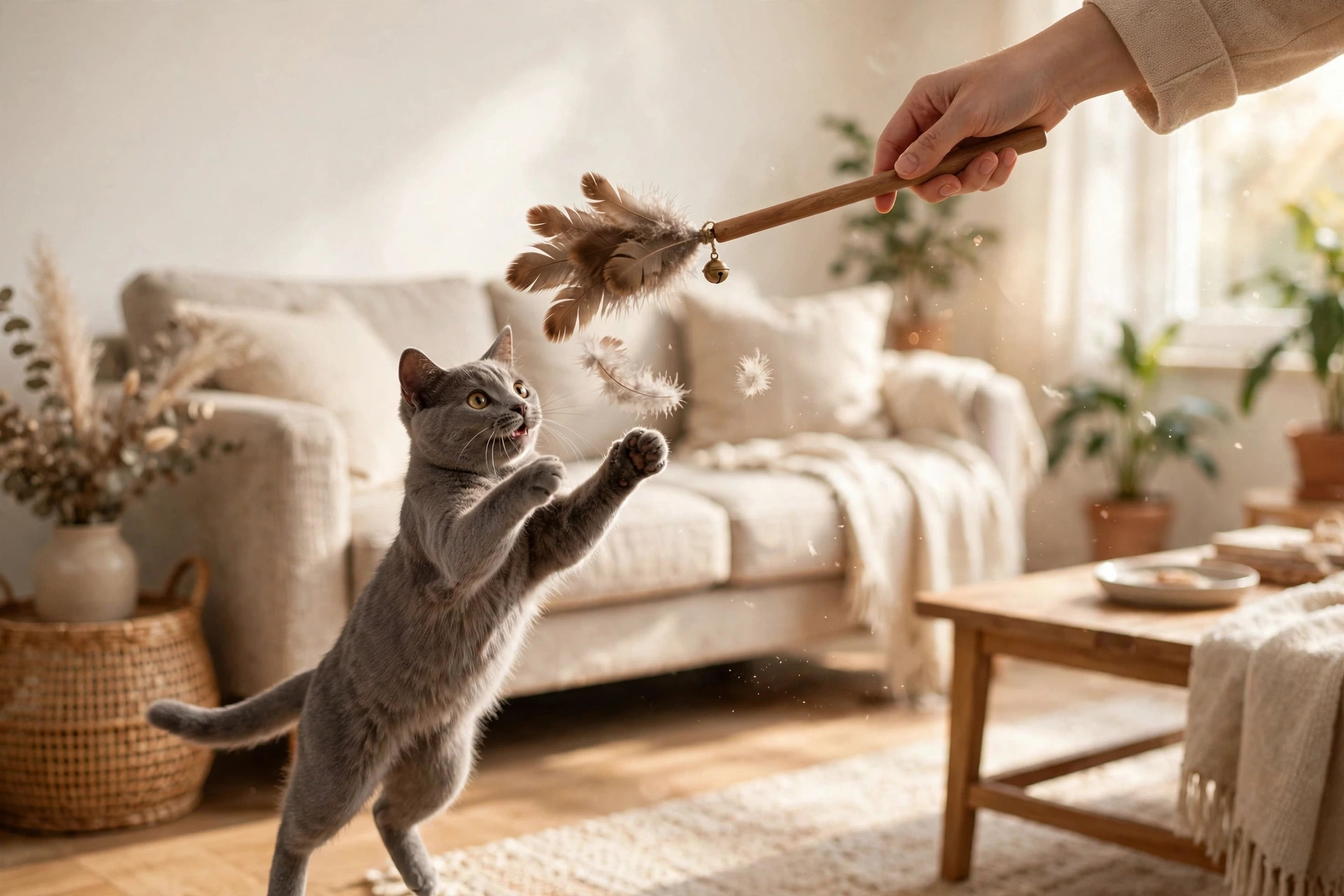
A feather wand isn’t a toy you wave randomly while scrolling your phone. Used right, it’s a full hunting simulation — and the structure matters more than you’d think.
Minutes 1–3: the stalk. Drag the feathers slowly along the floor, around furniture corners, pausing often. Let your kitten crouch and wiggle its butt. That butt-wiggle is the whole point — it’s the stalk phase, and skipping it is why so many people say “my cat gets bored of the wand in three minutes.” They never let the cat stalk.
Minutes 4–8: the chase. Now speed up. Flick the feathers like a bird changing direction. Let them catch it sometimes — a hunter that never catches anything gives up. Roughly one catch every minute keeps the game alive.
Minutes 9–10: the kill and the meal. Let your kitten “kill” the feathers, bunny-kick them, carry them off. Then — this is the part everyone skips — feed a small meal or treat right after. Hunt, catch, eat, groom, sleep: that’s the full feline sequence. End the game with food and your kitten will groom itself and pass out instead of hunting your toes at midnight.
Two weeks of this, once or twice a day, and the ankle ambushes drop off a cliff. Not because the kitten learned a lesson — because the hunting account is already paid in full.
Not all feather wands survive a real hunter
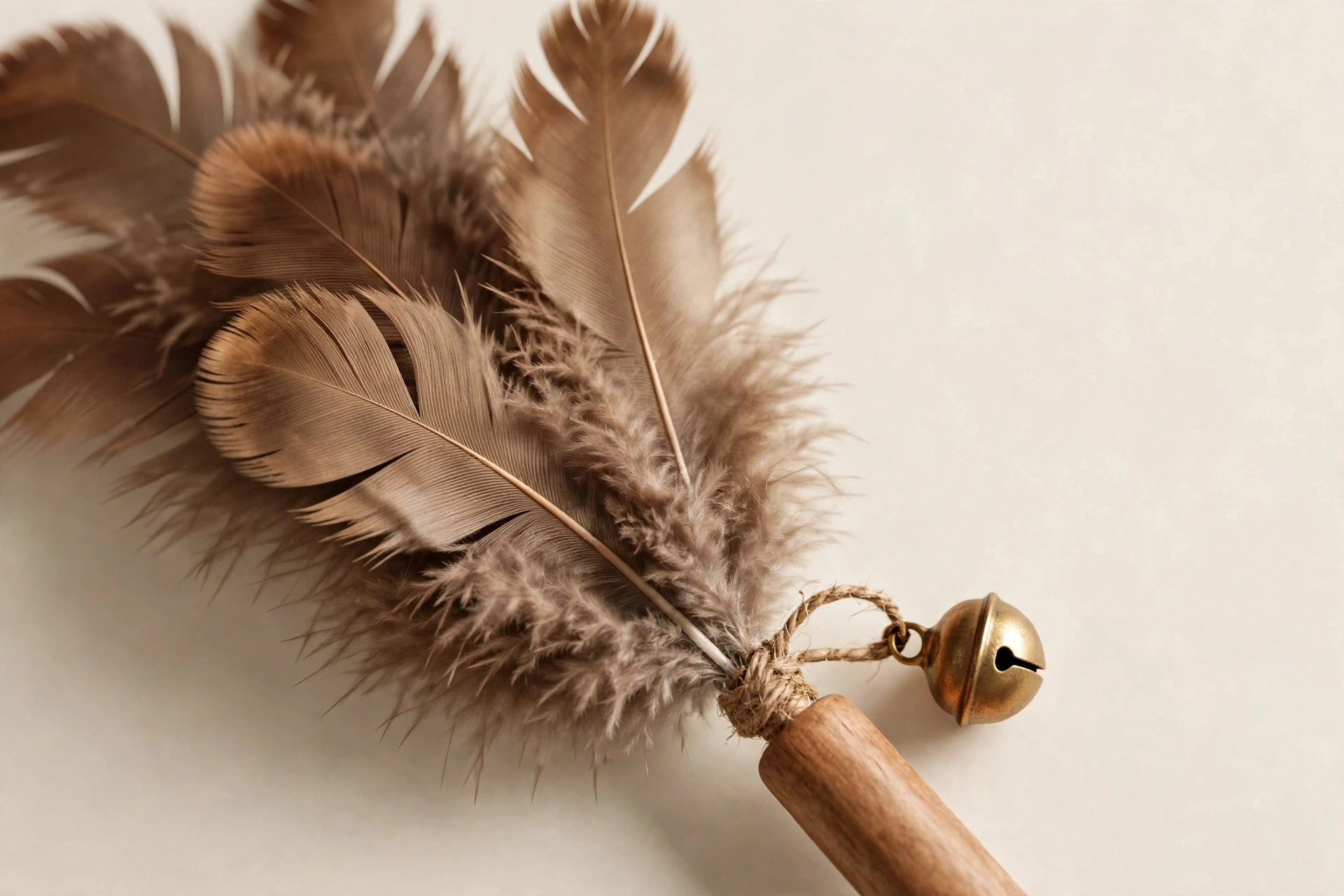
Now the opinionated part. Most cheap feather wands are garbage, and I say that as someone who bought a five-pack for $6 and watched my kitten destroy all five in a week. Dyed feathers glued to a bamboo stick: the glue fails, the stick snaps mid-pounce, and your kitten ends up chewing loose feathers. Skip them.
Here’s what actually matters in a wand, learned the hard way:
Real feathers, not dyed fluff. Cats can tell. Natural turkey and guinea fowl feathers have a texture and flutter that synthetic substitutes can’t fake — the barbs catch the air differently, and the subtle color variation reads as “real bird” to a cat’s eyes. The Flutter Wand’s head is about 15 cm of exactly that, and you can see the difference in the close-up above.
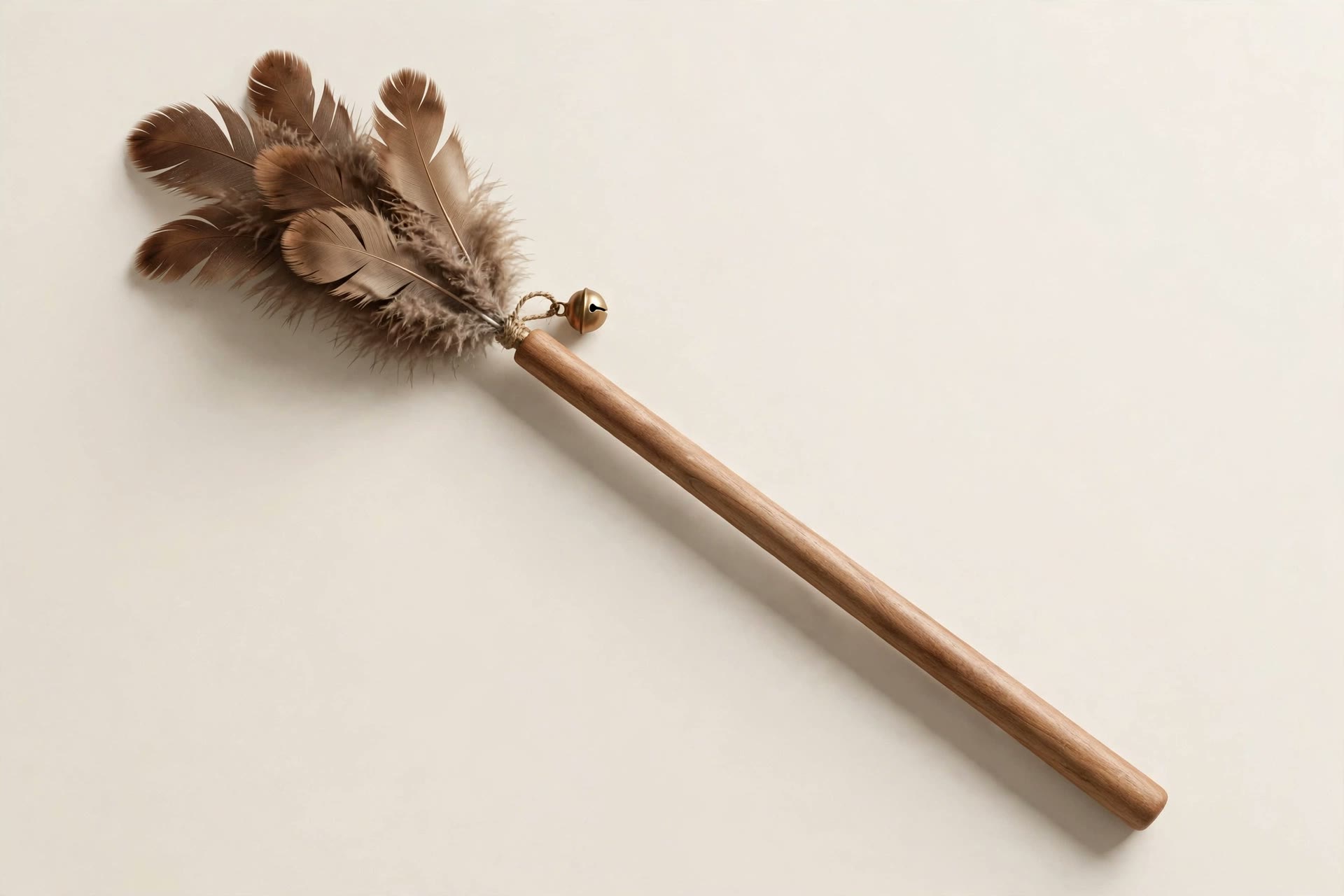
A rod that bends instead of breaking. When a kitten goes full predator — all four paws, full body weight, bunny-kicking — a rigid stick either snaps or yanks out of your hand. A flexible fiberglass rod bends with the chaos and whips the feathers through the air like a bird in flight. The 45 cm rod on this one has survived my cat’s worst, which is saying something.
Distance between your skin and the “prey.” This is the whole point of the exercise, right? A 90 cm cord means the feathers dance a full meter away from your fingers. Your hands stay safe from claws even when the game gets wild. Short-string wands defeat the purpose — you might as well dangle your hand in front of the kitten and call it a day.
One honest note from the product photos: the feather head carries a small brass bell. It’s an extra sound cue that drives sound-oriented hunters wild. If your cat is noise-sensitive, that’s what the quick-swap head is for — pop the head off in seconds and switch to a bell-free one. Replacement heads are available separately, which also matters because a chewed-up feather head should be retired, not repaired with hope.
The two rules that make it all work
Rule one: never leave the wand out. A feather wand on the floor is both a chewing hazard (string plus feathers, unsupervised — no) and a novelty killer. Put it in a closet after every session. A wand that only appears for hunt time stays exciting for months. One that lives on the floor becomes furniture by Thursday.
Rule two: hands are never toys. This one is on you, not the cat. The moment you wiggle your fingers at a kitten “playfully,” you’ve taught it that hands are prey. Redirect every time — fingers stop, wand appears. Consistency here is worth more than any product.
And when you’re not home? A wand needs a human. For solo hours, a self-rolling toy like the Zoomie Ball keeps the hunting brain busy until you’re back for the real session.
Try it tonight
Your kitten will bite you again tomorrow morning — habits don’t vanish overnight. But start the ten-minute hunt tonight, end it with a meal, and watch what happens over the next two weeks. The ankle ambushes fade. The 3 a.m. parkour sessions calm down. And you get the version of your kitten that curls up on your chest instead of attacking it.
That’s the trade: ten minutes of being the bird, and you get your ankles back.
Related products: Flutter Wand – Feather Teaser (natural turkey & guinea fowl feathers, flexible fiberglass rod, 90 cm cord, quick-swap head) · Zoomie Ball – Interactive Cat Toy (self-rolling ball for solo play when you’re not home)